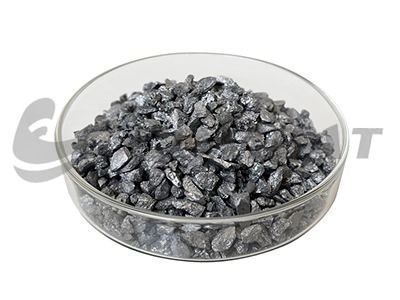


How to Choose Molybdenum Crucible for Laboratory Use
作者:kangbote 时间:2026-11-10 11:09:53
When choosing a molybdenum crucible for high-temperature melting, crystal growth, sintering, or vapor deposition processes, engineers are used to starting with material grade, wall thickness, or dimensional drawings. When choosing a molybdenum crucible for the laboratory, you can't just look at the "highest temperature resistance" or the purity on the catalog. The correct approach is to first confirm whether the molybdenum is suitable for the furnace atmosphere and charging chemical system, and then determine the purity, manufacturing route, size, wall thickness and acceptance documents. As long as one of them does not match the experiment, even if the crucible does not break immediately, it may change the experimental results through oxidation, deformation or trace element migration.
What Is Molybdenum Crucible?
Molybdenum crucible (molybdenum crucible, also known as moly crucible or moly cup in the industry) is a high-temperature resistant container made of high-purity molybdenum, with purity usually 99.95%, and TZM and Mo-La molybdenum alloys are also widely used. Its task is to hold the melt, evaporating material, sintering blank, or growing crystal under vacuum or inert atmosphere.
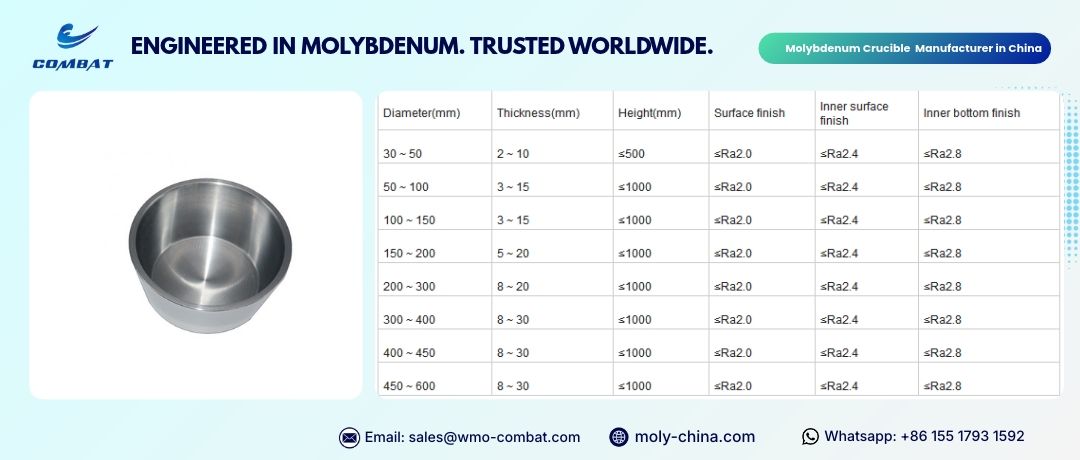
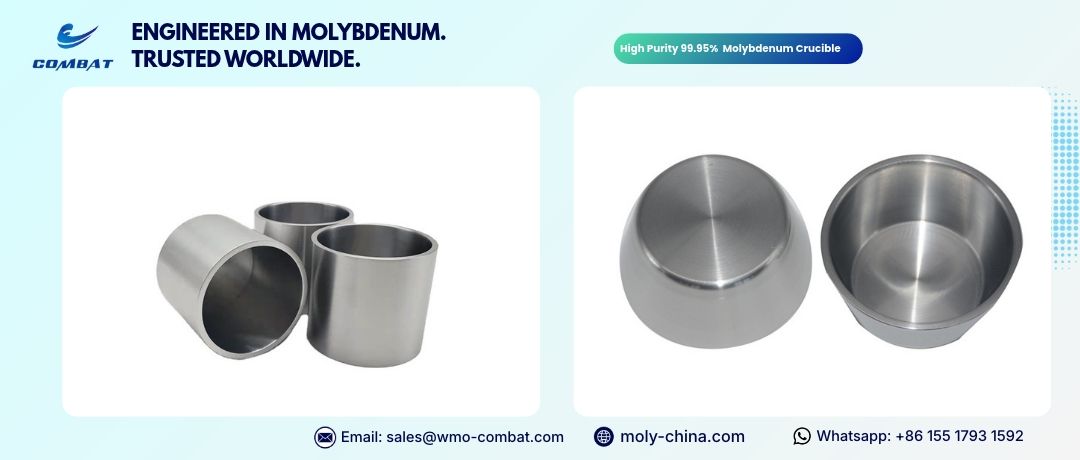
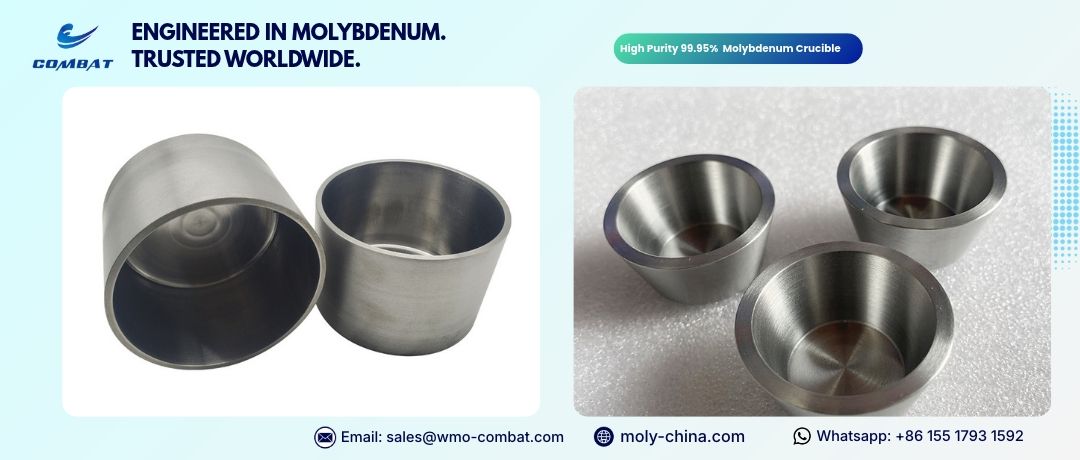
The form of molybdenum products is mainly straight-walled cylinder, with cone, cone bottom, rectangle and complete structure with cover. The outer diameter is usually 10-500mm, and some production lines are 700-800mm; Height 10-600mm, special parts can reach 750-1,000mm; Wall thickness 1-30mm.
The density of the molybdenum crucible is bound to the molybdenum manufacturing process. Sintered parts fall 9.8-10.0g/cm³, forged or screwed parts close to 10.2g/cm³. This difference is directly apparent in the yield in sapphire growth and semiconductor single crystals.
There is a boundary that must be written on the front: molybdenum is a refractory metal, not a ceramic. It relies on a protective atmosphere at high temperatures, which determines why the second level should be ranked first.
Why Can Molybdenum Withstand High Temperature?
The reason for choosing molybdenum can be pressed into six material characteristics. Each bar corresponds to a process consequence, not just the a sentence "superior performance".
Melting point 2,623°C
Molybdenum has a melting point of about 2,623°C(4,753 °F), which is higher than quartz, alumina, and most metals. The crucible wall remains solid and shaped at 2,000°C, and there is an upper limit to the melt temperature. Only a few materials such as tungsten, tantalum, and carbon have a higher melting point than molybdenum.
High temperature strength and creep resistance
The strength decay of molybdenum at high temperature is slower than that of ceramics, and the deformation rate of bearing is low. 1,800°C insulation for tens of hours, the crucible wall thickness and roundness change is very small, the melt level height can be repeated again and again.
Thermal conductivity about 138 W/m · K
The path of heat transfer from the heater to the inner wall of the molybdenum crucible is short, and the local overheating zone is small. The temperature difference between the upper and lower sides of the melt is narrowed, the solid-liquid interface of crystal growth is flatter, and the density of crystal defects is lower.
Low coefficient of thermal expansion
In the process of temperature rise and fall, the size change is small, and the thermal stress decreases. In the rapid cooling and rapid heating experiments, the main cause of crucible cracking is the temperature gradient, not the brittleness of the material itself.
Chemical stability and purity
High-purity molybdenum is stable to most molten metals, glasses and some non-oxidizing acids, and reacts weakly with the melt under vacuum or inert conditions. When the purity is more than 99.95%, the metal impurities entering the melt are calculated in ppm.
Low vapor pressure
The volatilization of molybdenum itself under vacuum is limited and will not become a source of pollution in the furnace chamber. Thin film deposition and single crystal growth are particularly sensitive to this: what evaporates from the crucible will eventually fall into the film or crystal.
Application of Molybdenum Crucible in Laboratory
The same is the molybdenum crucible, different working conditions to get the hand of the 1, brand and wall thickness may be completely different.
- Sapphire single crystal growth:Kyropoulos or heat exchange method, the crucible is filled with molten Al₂ O₂. Purity, density and dimensional stability go directly into crystal quality indicators.
- Rare earth metal smelting:alloys such as neodymium and praseodymium are melted in a high vacuum or inert atmosphere, and the crucible cannot send oxygen to the melt, nor can it bring in iron and nickel.
- Quartz and special glass melting system:for long-term heat preservation above 1,700°C, the uniformity of wall thickness determines the service life, and the thinner part will be worn first.
- Semiconductor single crystal growth:for processes such as Czochralski and Bridgman, the 99.99 percent level is more common because impurities become electrical defects directly.
- Vacuum Evaporation and PVD:the molybdenum crucible doubles as an evaporation source, and thin wall, low vapor pressure, and smooth inner wall are 3 keys.
- High temperature sintering and brazing:1,600-2,000°C, the loading weight, the bottom thickness should be given separately, and the side wall size cannot be used.
- Materials and Metallurgy Research:parameters are often changed, and universal size, reformability, and delivery time are more important than ultimate performance.
Select Right Temperature Of Molybdenum Crucible
2,623°C says when molybdenum melts, not how long the crucible can last. What really determines life is creep: the material deforms slowly over time under a constant load, the lower the temperature, the slower the deformation, but it never stops.
Creep is very specific in the lab. The crucible wall bulges outward, the roundness becomes poor, the wall thickness near the liquid surface line is thinned, and the lid is stuck on the mouth and cannot be pulled out.
Record the outer diameter and wall thickness after each opening. After two 3 of the furnace, the curve comes out, closer to your own furnace than any parameter table.
|
Materials |
practical upper limit |
Atmosphere condition |
Life-limiting failure modes |
|
Pure Molybdenum (Mo-1) |
1,700-2,000°C |
Vacuum/Inert/Reducing |
Creep, grain coarsening, wall thickness reduction |
|
Approximately 1,900°C or slightly higher |
Vacuum/Inert |
Creep under long-term loading, but at a lower rate |
|
|
1,800-1,900°C |
Vacuum/Inert |
It will still deform after repeated cycles, and its resistance to embrittlement is better than that of pure molybdenum. |
|
|
2,400-2,800°C |
Vacuum/Inert |
High temperature strength is higher, but processing is difficult and heavy |
|
|
Silicide coated molybdenum |
Approximately 1,700°C |
Air available |
Rapid local oxidation of the coating after wear |
Select The Working Atmosphere Of Molybdenum Crucible
The atmosphere is the only variable that can directly veto the molybdenum crucible. The same crucible can run hundreds of furnaces in a vacuum furnace, but it may not live to heat up once in an air furnace.
|
Type of atmosphere |
Whether applicable |
Practical upper limit of pure molybdenum |
Main Risks |
|
Vacuum |
Recommended |
1,700-2,000°C |
Misjudgment of the discharge of the first furnace and reflux of pump oil |
|
Argon/Helium |
Recommended |
1,700-2,000°C |
Insufficient gas purity and incomplete replacement |
|
Hydrogen/hydrogen-containing gas mixture |
Available, secure configuration required |
1,700-2,000°C |
Deflagration risk, dew point control |
|
Air/oxygen-containing atmosphere |
Prohibit high temperature use |
Short time below 400°C |
Oxidation consumption, MoO sublimation |
Purity And Grade Of Molybdenum Crucible
Boundary between 99.95 and 99.99 molybdenum
99.95% molybdenum crucibles are the industry's default standard and are adequate for most laboratory conditions. 99.99% used in impurities will directly enter the acceptance index of the occasion: LED grade sapphire, optical crystal, advanced semiconductor.
The judgment method is enough in one sentence: if the impurities exceed the standard, your finished product will fail the inspection, buy a higher level; if not, the budget will be spent on density or wall thickness, and the return will be higher.
Pure Molybdenum vs Molybdenum Alloy: Molybdenum Crucible Comparison
|
Brand |
Typical Purity |
In exchange for the advantage |
The price paid and the typical occasion |
|
Mo-1 |
99.95%, up to 99.99% |
The highest purity, good thermal conductivity, the lowest risk of pollution, general high temperature performance stability |
The high temperature strength is lower than the alloy. Used for sapphire, semiconductor single crystal, high purity smelting, evaporation source |
|
Mo-2 |
99.90% |
Low cost, enough for ordinary working conditions |
Not suitable for impurity sensitive processes. For general metallurgy, non-sensitive sintering |
|
TZM |
About 99.2%(Mo +0.5% Ti +0.08% Zr + C) |
High strength at high temperature, good creep resistance, high recrystallization temperature |
Purity gives way to strength. For heavy load, long time high temperature, furnace parts |
|
Mo-La |
Doped 0.3-0.7% La₂ O₂ |
Resists grain coarsening and maintains ductility after repeated cycles |
Purity is lower than pure molybdenum. For thin-walled parts, frequent thermal cycling |
TZM addresses load-bearing and creep at the expense of reduced purity. Mo-La solves the embrittlement of thin-walled parts after repeated temperature rise and fall, at the same cost of purity. When the melt is sensitive to impurities and the mechanical load is not heavy, it is more cost-effective to stay in pure molybdenum.
Molybdenum Crucible Size: Diameter, Height And Wall Thickness
Furnace clearance 5-10mm
Leave 5-10mm between the outer diameter of the crucible and the heater or hot zone wall. This gap gives thermal expansion and also the passage of air flow. When you measure the hot zone, do not measure the furnace shell.
The aspect ratio follows the process
The height of crystal growth is usually 1.5-2 times the diameter, so that the melt depth is sufficient and the axial temperature gradient is stable. Evaporation and rapid melting in reverse, short and wide, heating up quickly, take the material smoothly.
Upper size limit determined by process
Most of the crucibles added by forging machines have an outer diameter of about 130mm, and the accuracy and density are guaranteed. Further up the sintering or spinning, the cost is more reasonable, the price is to relax the tolerance.
Molybdenum crucible wall thickness
The thin wall heats up fast, the temperature difference is small, but the deformation resistance is weak; the thick wall is durable, the temperature rises and falls slowly, and the material cost is also high. The 3 interval is sufficient to cover most laboratory needs.
|
Wall thickness interval |
mm |
Typical Uses and Risks |
|
Thin wall |
1-5mm |
Laboratory small size molybdenum crucible, evaporation source, spinning lining. Fast thermal response, low load-bearing capacity, easy to deform when loading heavy materials |
|
Middle wall |
3-10mm |
The general interval, strength and thermal response balance of most crystal growth and high temperature melting |
|
Thick wall |
More than 8-20mm |
Large diameter, heavy load, long time heat preservation. Slow temperature rise and fall, high material cost, longer preheating program |
The bottom thickness is often given separately. Generally equal to or greater than the side wall, because the melt weight and thermal stress are pressed at the bottom, this one is thin, and all previous strength calculations are not valid.
Shape of molybdenum crucible
Flat bottom: general melting and most crystal growth, processing is simple, easy to clean.
Round or hemispherical bottom: the melt flow is smoother, the stress concentration is small, and the discharge and demoulding are labor-saving.
Cone bottom: directional solidification, Bridgman process, improve the axial temperature gradient, easy to take crystal.
Pointed bottom: vertical Bridgman or gradient solidification, designed for a particular ingot shape.
Bottomless: continuous feeding or special structure, used with downstream receiving device.
Strengthening bottom: the bottom is thickened separately to deal with heavy melt and bottom thermal stress.
Tolerances of molybdenum crucibles
The tolerance of the machine-added molybdenum crucible is ± 0.5-2mm, and the sintered part is ± 5mm. The former is expensive in processing hours, while the latter is cheap in large-size molding.
The same tolerance requirements, falling on different processes on the price difference of 1 times. Before marking the tolerance on the drawing, think clearly whether this place needs to be so tight.
How Is The Molybdenum Crucible Manufactured?
Four routes vary in density, size, and accuracy. Most of the price difference comes from here, not the molybdenum powder market.
- Press Sintering:molybdenum powder is cold isostatically pressed or molded, and then sintered in a hydrogen or vacuum atmosphere at 1,800-2,000° The cost advantage of medium to large quantities and large sizes is obvious, the density is 9.8-10.0g/cm³, and a small amount of residual pores is allowed.
- Forging plus machine plus:sintered blanks are forged or swaged to refine the grains, with a density of about 10.2 g/cm, and then turn-milled to size. Precision and density is the best, suitable for small and medium size of high requirements.
- Spinning or deep drawing:after heating, the molybdenum plate is spin-formed on the core mold, seamless, thin wall and large diameter. The large crucible of the sapphire furnace takes this route.
- Welding and assembling:sheet metal is welded into cylinder and bottom, suitable for oversized or special-shaped structures. The quality of the weld determines the success or failure, and also determines whether this crucible can enter the high purity process.
|
Route |
Typical Density |
Applicable dimensions |
Advantage |
Main use |
|
pressing and sintering |
9.8-10.0 g/cm³ |
Medium to large size |
Low cost, scalable, molding freedom |
General purpose melting, large size crucible |
|
Forging and machine-processing |
Approximately 10.2g/cm³ |
Medium and small size |
Highest density and strength, tightest tolerance |
High purity crystal growth, precision parts |
|
Spinning/deep drawing |
10.1-10.2 g/cm³ |
large diameter thin wall |
Seamless, good thermal conductivity, uniform wall thickness |
Sapphire furnace, large thin-walled vessel |
|
Welding and assembling |
Fluctuation with weld and base metal |
Oversized or Alien |
Highest geometric freedom |
Industrial shaped parts, non-high purity occasions |
The price logic follows the process: sintering costs according to size, machine charging according to precision, spinning is dominant on large diameter and thin wall, and welding solves shapes that others cannot make.
Welds are weak points and sources of pollution. Penetrant testing or ultrasonic testing is required for acceptance, and do not only look at the appearance. In the high-purity process, an unpolished weld is enough to degrade the entire furnace melt.
Comparison Of Molybdenum Crucible With Other Materials
Put molybdenum in the middle of these five materials to make a clear choice. Each 1 has its own temperature window and atmosphere conditions, and no 1 is optimal for the whole scene.
|
Indicators |
Molybdenum |
Tungsten |
Graphite |
Alumina |
Quartz |
Platinum |
|
Melting point or softening point |
2,623°C |
3,422°C |
Sublimation above 3,000°C |
Above 2,000°C, softening earlier |
Softening from about 1,700°C,1,100-1,200°C |
1,768°C |
|
practical upper limit |
1,800-2,100°C |
2,400-2,800°C |
Above 2,000°C |
1,600-1,700°C |
1,100°C |
1,600-1,700°C |
|
Atmosphere |
Vacuum/Inert/Reducing |
Vacuum/Inert |
Vacuum/Inert/Reducing |
Air available |
Air/Vacuum/Inert |
Air/Inert |
|
Pollution risk |
Low (high purity) |
Extremely low |
High (increased carbon) |
Low to medium |
very low |
Extremely low |
|
heat conduction |
About 138 W/m · K |
About 170 W/m · K |
Excellent |
Medium |
Low |
Medium |
|
relative cost |
Medium |
High |
Low to medium |
Low |
medium to low |
Extremely high |
How To Choose A Molybdenum Crucible Manufacturer?
- First distinguish molybdenum material manufacturers and traders. Q 1 sentence: Sintering, forging, spinning, mechanical processing, testing, which are done in your own factory.
- Customized services: tolerances, inner wall roughness, coating capacity, maximum outer diameter, and standing grades that can be achieved according to the drawings.
- Stable supply: can the on-time delivery rate be stable above 95%, the response time of technical problems, willingness to give batch data, and whether the packaging has covered the inner hole. A transport scratch on the inner wall of the crucible is a nucleation point in crystal growth.
Frequently Asked Questions about Molybdenum Crucible
Q: Where is the molybdenum crucible mainly used?
The laboratory focuses on several types of processes: sapphire and semiconductor single crystal growth, rare earth metal melting, quartz and special glass melting, vacuum evaporation and thin film deposition, high temperature sintering and brazing at 1,600-2,000°C, and materials research requiring high purity environment. Common is high temperature, vacuum or inert atmosphere, sensitive to impurities.
Q: How high is the temperature of using molybdenum crucible?
The practical range of pure molybdenum under vacuum or inert atmosphere is 1,700-2,000°C, and the melting point itself is 2,623°C. Above 1,800°C, creep and grain coarsening begin to be evident and life is shortened. TZM and Mo-La can provide better creep resistance in this range, and tungsten should be considered for sustained above 2,200°C.
Q: Can molybdenum crucible be used in vacuum?
Vacuum is the most suitable working condition. Without oxygen, oxidation failure is ruled out, and the low vapor pressure will not pollute the furnace chamber. Do sapphire, evaporation coating and high purity melting experiments, vacuum is almost the default option.
Q: Can molybdenum crucible be used in the air?
You can't. At about 400°C, it starts to oxidize obviously, and volatile MoOover is generated at 600-700°C, and the wall thickness decreases rapidly. Silicide coating can hold up to about 1,700°C, but the coating will fail locally after wear, and laboratory conventional crucibles are rarely used.
Q: What is the wall thickness of the molybdenum crucible?
1-30mm molybdenum crucible covers most needs. Thin wall 1-5mm, suitable for small crucible and evaporation source, fast heating but weak load-bearing; Middle wall 3-10mm is the general range of crystal growth and smelting; More than 8-20mm is used for large diameter and heavy load. The bottom thickness is generally equal to or greater than the sidewalls.
Q: Is the purity of molybdenum crucible 99.95 or 99.99?
99.95% molybdenum crucible is standard configuration, most laboratories enough. For LED-grade sapphire, optical crystal or semiconductor single crystal, impurities will directly affect the finished product index, up to 99.99. There is only one criterion for judging whether excessive impurities will make your inspection unqualified.
Q: How to choose molybdenum crucible and tungsten crucible?
Tungsten crucible is selected above 200°C, its melting point and high temperature strength are higher. In the range of 1,500-2,100°C, molybdenum is lighter, better processed, cheaper and more suitable for heat conduction. Both require a vacuum or inert atmosphere.
Q: Can you customize the molybdenum crucible according to the drawing?
You can. Outer diameter, height, wall thickness, bottom form, cover, flange, opening, surface roughness and grade can be made according to the drawing. When submitting the drawings, write down the tolerance, atmosphere, temperature and service cycle together, so that the quotation and process plan are right.
Q: How to clean and store molybdenum crucible?
Use molybdenum crucible solvents or mild chemical methods recommended by the supplier to avoid strong acids attacking the grain boundaries. Residual melt is first mechanically removed and then cleaned. Store in a dry and clean place, avoid bumping when handling, molybdenum will become brittle after high temperature use, and may crack after being knocked. The temperature rises and falls slowly according to the procedure. Don't open the furnace door suddenly.
Conclusion
COMBAT Metal's production line covers molybdenum powder preparation, forging, spinning and precision machining. Molybdenum, TZM and molybdenum lanthanum are always available. Crucibles can be customized according to drawings. When inquiring, the atmosphere, maximum temperature, heat preservation duration and monthly cycle times are given together, and the engineer can directly return the 1 brand and wall thickness suggestions.