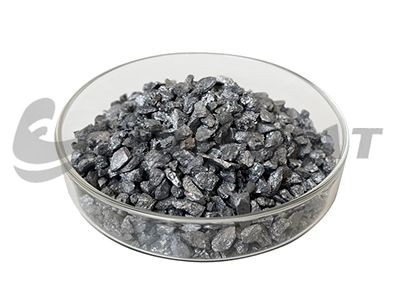


How to Choose High Quality Tungsten Rods? Complete Guide
作者:kangbote 时间:2026-06-08 18:19:01
As the core profile of refractory metal, tungsten rod, with its unique physical properties such as ultra-high melting point of 3422℃, high density and strong corrosion resistance, is used in a large number of harsh working conditions. However,the quality of tungsten rods on the market varies. This article is organized to help factory purchasing and process engineers to select the best tungsten rods for the working conditions and long life.
Understanding tungsten rods and performance
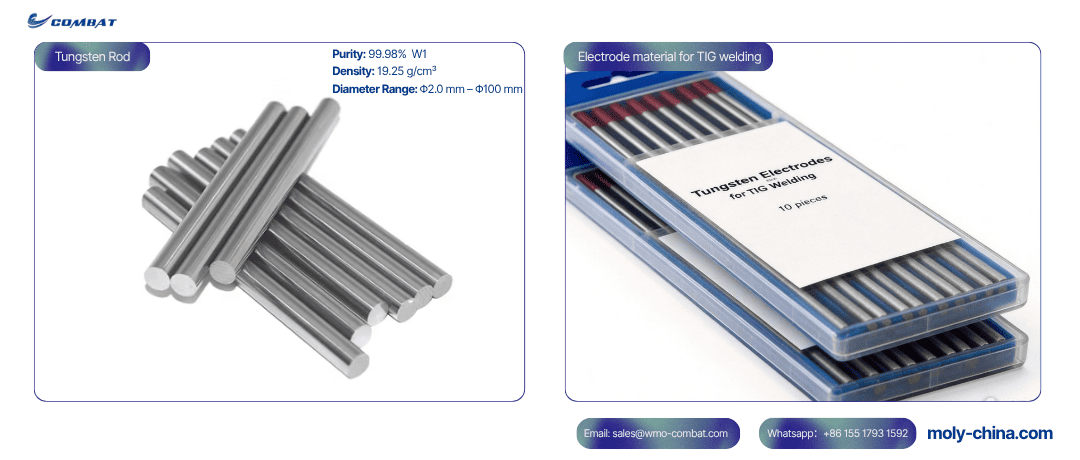
Tungsten rods are cylindrical solid profiles made of tungsten metal as the main raw material, the industry's mainstream relies on powder metallurgy process molding, divided into two categories of pure tungsten rods and tungsten alloy rods.
Tungsten is the metal with the highest melting point in nature, with a melting point of up to 3422°C, which is only lower than that of carbon. It can work stably for a long time in a high-temperature vacuum and inert atmosphere, and will not soften and deform easily.
The theoretical density of pure tungsten reaches 19.3g/cm³, which is close to that of gold, and is 2 times that of steel and 1.7 times that of lead.
Its high density makes it the preferred material for counterweight, radiation shielding, and armor-piercing components.
At the same time, it has high tensile strength, surface hardness and excellent wear-resistant performance; low coefficient of thermal expansion, stable thermal and electrical conductivity, and extremely low vapor pressure at high temperature, which makes it not easy to volatilize and lose. Pure tungsten brittleness at room temperature is large, after forging, spin forging deep processing, toughness and processability will be significantly improved. In addition, tungsten has outstanding corrosion resistance in conventional acid and alkali environments, and a dense oxidized protective layer will be formed on the surface in medium temperature environments.
Types of tungsten rods
Pure tungsten rod
The tungsten content of industrial grade is ≥99.95%, and the purity of ultra-high purity type can reach 99.999% (5N level). The main features are extreme high temperature resistance, low impurity and low outgassing, which are mostly used in high temperature heaters, vacuum furnace parts, and high-precision electronic contacts.
Doped Alloy Tungsten Rods
Lanthanum, cerium, thorium, zirconium and other rare earth elements are added to the pure tungsten matrix, and the core use is to make argon arc welding electrodes.
Different doping formulas can optimize the arc starting ability, arc stability, and burn resistance. Among them, thoriated tungsten is radioactive, and the industry is gradually reducing the proportion of its use.
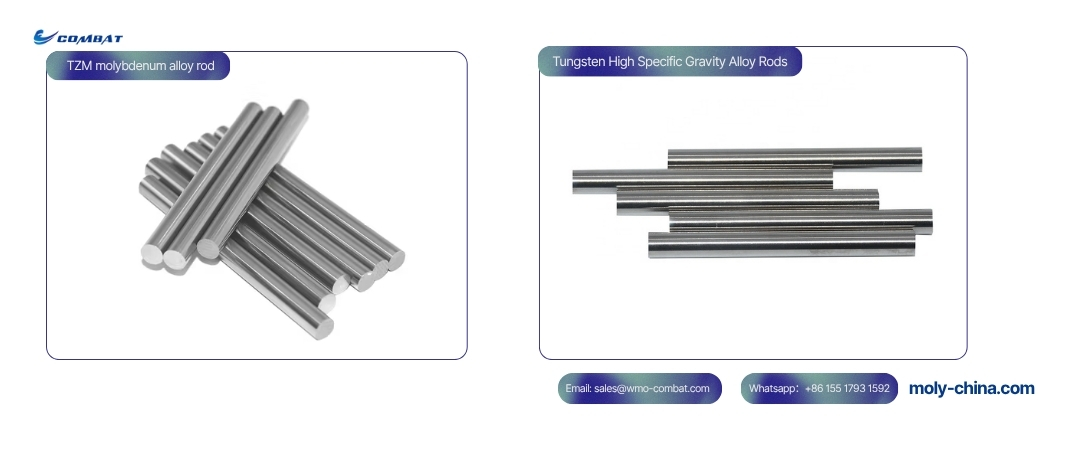
Tungsten High Specific Gravity Alloy Rods
The general ratio is tungsten + nickel-iron/nickel-copper, with tungsten content ranging from 90% to 97%. Density range 16.5-19.0g/cm³, better toughness than pure tungsten, less difficult to cut and process, suitable for counterweights, shielding, low-speed workpiece parts, can not withstand ultra-high temperatures and long-term operation.
How is tungsten rod produced?
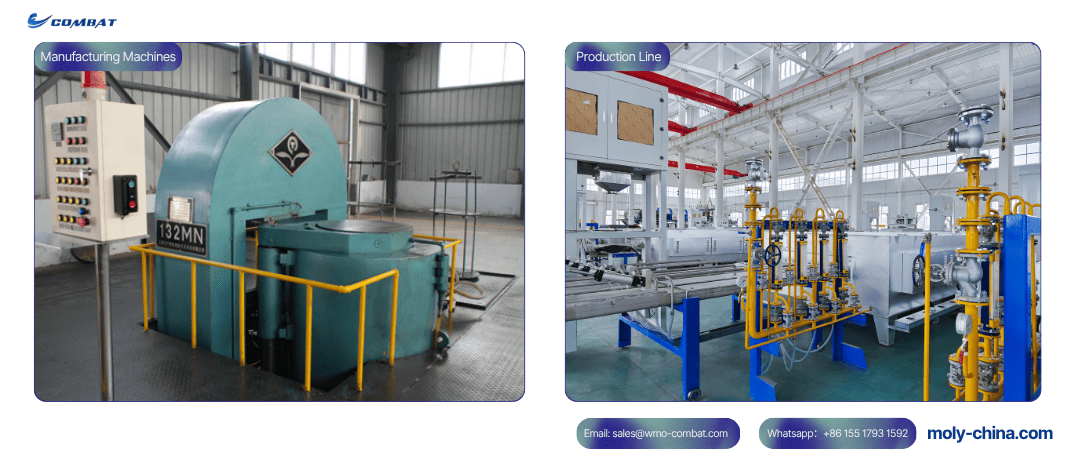
Due to the limitation of ultra-high melting point, tungsten rods cannot be produced by traditional melt casting, and are processed by powder metallurgy system throughout the whole process:
Step 1: High-purity tungsten powder is pressed into cylindrical blanks through molds.
Step 2: low-temperature and high-temperature segmented sintering, so that the powder particles are closely combined with the molding.
Step 3: sintered blanks are then forged, spun forged and drawn to improve the densification and mechanical properties.
Step 4: Finishing grinding and mirror polishing to produce finished products with different surface finishes.
The regular supply of tungsten rods covers diameters from 0.5mm to 200mm, and the lengths can be customized according to the requirements, and the basic material specification of ASTM B760 is implemented in the international market.
10 points for choosing high quality tungsten rods
1 Purity Grade of tungsten rods
Purity directly determines the stability of tungsten rods at high temperature, the amount of impurity precipitation, and the uniformity of electrical and thermal conductivity. Excessive impurities will lead to a series of problems such as high temperature outgassing, localized melting point drop, and arc shaking.
For general industrial welding and furnace components, it is recommended to use 99.95% pure tungsten base material. Semiconductor, vacuum lighting, high precision electronic components scene, must use 99.999% ultra-high purity tungsten rods, strict control of iron, molybdenum, silicon, carbon, oxygen and other trace impurities.
When purchasing, be sure to ask the supplier for the CoA composition analysis report, the report needs to be clearly labeled with the value of each impurity content, and it is not recommended to place bulk orders for products without test reports.
2 Density and metallographic microstructure
The internal metallographic organization of high-quality tungsten rods has fine grains and uniform arrangement. Coarse grains, local looseness, inclusions of black spots are process defects, and are very easy to stress cracking and rapid wear and tear in use. Formal manufacturers can provide metallurgical testing snapshots as evidence of quality.
3 Molding process and surface condition
The same tungsten rod, sintered state, forging state, spin forging state performance is extremely different. Only sintered and unforged blanks are weakly dense and brittle, and are only suitable for low load and non-precision rough machining scenarios. After forging, spin forging deep processing of tungsten rods, the internal pores are compacted, tensile strength, creep resistance, impact resistance upgraded comprehensively, is the first choice for high temperature load bearing, welding electrodes.
Surface treatment is divided into sintered blank surface, rough grinding, fine grinding, mirror polishing. Welding electrodes and vacuum sealing parts must use fine grinding/polishing surface without cracks, pits, oxidized skin; ordinary counterweight rough machining parts can use sintered blanks to control costs.
4 Industry standard compliance
International general authoritative standards need to be strictly aligned to avoid non-standard non-standard material performance does not meet the standard:
ASTM B760: for pure tungsten alloy-free profiles, including the basic requirements of the chemical composition;
ASTM B777: special specifications for tungsten high specific gravity alloys of the density, mechanics, composition category;
AWS A5.12: tungsten electrodes for tungsten tungsten argon arc welding special implementation standards; supporting the ISO, GB/T, aerospace AMS system standards, according to the need to match the industry qualification.
The MTR factory material test sheet is attached with the shipment of regular manufacturers. Manufacturers with ISO9001 and AS9100 system certifications have a more stable quality control system, with less color difference and performance fluctuation in batches.
5 Dimensional Tolerance and Outline Precision
The diameter of tungsten rods ranges from 0.5mm wire electrodes to large 200mm industrial solid rods, and the tolerance requirements for each type of working condition are very different. For precision consumables such as argon arc welding electrodes, the diameter tolerance is often required to be within ±0.025mm, and dimensional deviations can lead to unstable clamping and uneven current distribution. Large furnace support bar tolerance requirements can be moderately relaxed, but straightness must meet the standard, bending deformation can not be assembled.
The length of all support for fixed-size cutting, clearly marked tolerance range, straightness standards, receipt of the first time with micrometers, calipers, actual measurement verification.
6 Doping / alloy formula (welding electrode key)
Different welding base metal, AC and DC welding machine, corresponding to the exclusive doped tungsten electrode formula, the wrong choice directly affects the welding molding:
Pure tungsten (green logo): suitable for AC welding aluminum and magnesium alloys, stable ball forming;
Lanthanum tungsten (gold / blue logo): the most versatile, AC and DC universal, fast arc starting, low burn loss, stainless steel, titanium alloy, carbon steel precision welding preferred;
Cerium tungsten (gray-orange logo): small-current precision welding of thin parts, an environmentally friendly alternative to radioactive thorium tungsten;
Thorium tungsten (red logo): high-current DC steel welding performance, but with radioactive dust, most factories have been restricted to use;
Zirconium tungsten (white marking): AC high current working condition, excellent anti-pollution ability.
Non-electrode high-temperature parts give priority to pure tungsten; tungsten-nickel-iron/nickel-copper high specific gravity alloy is used for counterweight and shock absorbing parts.
7 Mechanics and measured performance
In addition to paper parameters, actual mechanical indexes determine the service life: hardness, room temperature tensile strength and high temperature creep resistance are indispensable.
For tungsten electrode rod to focus on the assessment of three practical performance: the ease of starting the arc, arc stability, unit time end ablation rate. High-temperature furnace tungsten rod focus on high-temperature long-term creep deformation, oxidation resistance. Shielded counterweights focus on verifying the overall density uniformity, cutting chipping.
Reliable suppliers can provide the same batch of samples, allowing customers to verify the performance of small batch trial production on the machine.
8 Supplier strength and quality control traceability
Priority is given to vertical factories that own the whole chain of tungsten powder smelting, molding and deep processing; trade intermediaries are prone to mixing batches and substituting good for bad.
Verify the qualification of the factory: quality system certification, third-party authoritative testing qualification, past aviation / medical / large-scale welding equipment factory cooperation cases. Complete traceability system is essential, each batch of raw materials, sintering furnace number, processing records can be queried, quality problems can be accurately traced back to the rectification.
Rejection of small retail sources without factory address, no testing, no after-sales, seemingly low unit price, comprehensive loss of rework costs are extremely high.
9 customized tungsten rods
Selection can not copy other people's programs, refine the requirements around their own use of the environment: Welding scenarios: matching the welder AC and DC, base material, commonly used current range, welding station; High-temperature furnace: distinguish between a vacuum / inert atmosphere / air environment, the air at high temperatures of tungsten oxidization, need to be matched with a protective atmosphere; Medical shielding: must be free of harmful radioactivity, non-toxic formulas, the standard for the medical industry testing specifications; Aviation and military: Rigorous flaw detection, mechanical sampling, complete traceability documents are indispensable.
There are special sizes, shaped ends, customized doping ratio needs, regular manufacturers can provide OEM/ODM custom processing.
10 cost, delivery and safety practices
Purchasing price comparison can not only look at the single kilogram unit price, to account for the full life cycle cost: high quality tungsten rods, slow loss, less downtime, low scrap rate of the workpiece, the long-term comprehensive cost is lower.
Communicate in advance the production lead time, large size, ultra-high purity, special alloy rod production cycle is longer, reserve stock buffer time. Safety operation points must be emphasized: tungsten rods are of great self-weight, handling is anti-smashing; tungsten dust generated by grinding and cutting is strictly prohibited from inhalation, and the workstation is equipped with ventilation and dust removal; thoriated tungsten electrodes are stored and handled in accordance with the norms of radioactive material management.
Methods of checking the quality of tungsten bars
Written document verification
Before placing an order, ask for samples with CoA composition analysis sheet and MTR material test report. Check whether the purity, density and hardness values in the report match with the purchased grades, and confirm that the standard numbers ASTM/AWS/ISO are complete.
Check the validity period of the manufacturer's system certificate. Goods without any paper test certificates have the highest risk of direct rejection. All documents are retained in the archives for subsequent quality traceability.
Non-destructive visual inspection of appearance and size
Visual inspection of the external surface of the bars batch by batch: cracks, honeycomb craters, oxidized black spots, bumps and chips are not allowed. Fine internal cracks can be detected by penetration flaw (color flaw).
Use micrometer to measure tungsten bars diameter at multiple points, calipers to measure the total length, rolling inspection of the whole straightness; welding electrodes to check the end color marking, to prevent manufacturers from mixing the wrong type of shipment.
Accurate test of tungsten rod density
Pure tungsten density is to distinguish adulteration, porosity defects in the core scale, recommended Archimedes buoyancy method, ordinary laboratory balance can be operated.
Steps: Weigh the dry weight of tungsten rods in the air, then completely immerse them in pure water and weigh the wet weight, and calculate the actual density by discharging the volume of water. The closer the measured value of pure tungsten is to 19.3g/cm³, the better the densification; the value is lower than 18.5, basically determining that the sintering process is not qualified.
Simple rough calculation program: Measure the diameter and length of the bar to calculate the theoretical volume, total weight ÷ volume to quickly compare the density range, suitable for large quantities of rapid screening.
Choosing tungsten rod according to their application
TIG welding electrodes (most used in the market)
Aluminum, magnesium alloy AC welding: standard pure tungsten green head, high-current conditions can be upgraded zirconium tungsten white head to enhance the current-carrying capacity. Carbon steel, stainless steel, titanium alloy DC welding: preferred blue standard / gold standard lanthanum tungsten, adaptable to high and low current, environmental protection and no radiation; cerium tungsten gray-orange models for small current thin parts.
Diameter strictly matches the current size: 1/16 tungsten rod is suitable for small current precision welding tungsten electrode, 3/32 inch is the most versatile, and 1/8 tungsten electrode rod is suitable for high current thick plate welding. Lanthanum tungsten is preferred for long-term and large-volume welding, replacing old thoriated tungsten and avoiding the risk of environmental protection and security inspection.
High-temperature industrial furnace, heating element, crucible
Vacuum, hydrogen inert atmosphere high-temperature equipment, unified selection of ≥ 99.95% high-purity forging tungsten rods. 3422 ℃ melting point can withstand more than 2,000 degrees sustained high temperature, excellent creep resistance.
Air environment, high temperature caution with pure tungsten, high-temperature oxidation will quickly consume the workpiece; potassium-doped modified tungsten can be used to slightly improve the high-temperature anti-sagging ability. High specific gravity tungsten alloy maximum withstand temperature is only about 1450 ℃, is strictly prohibited to be used in ultra-high-temperature furnace structural components.
Aerospace and Defense Parts
Counterweights for aircraft and satellite control surfaces, and shielding parts for satellite instruments: tungsten-nickel-iron high-specific gravity alloy rods, with high density and small volume, and much better cutting and processing performance than pure tungsten.
Rocket nozzles, high-temperature turbine accessories, high-speed and high-temperature resistant structures: forged high-purity tungsten rods to ensure high-temperature strength without deformation. Kinetic energy penetration components use high tungsten content spin forged alloy rods, relying on high density to achieve self-sharpening penetration characteristics.
Medical equipment and radiation shielding
X-ray machine collimators, radiotherapy equipment shielding tanks, isotope storage containers, a complete replacement of traditional lead materials, the use of non-toxic tungsten high specific gravity alloy.
Compared with lead, tungsten alloy is smaller in size with the same shielding effect, no heavy metal toxicity, and easier and safer to dispose of in hospitals. tungsten rods with high purity and polished are used for X-ray anode targets and emitters.
Balance weights, vibration damping tooling and tool blanks
Crankshaft balancing blocks, machine tool boring bars, precision equipment vibration damping weights, dart weights: tungsten-nickel-iron alloy rods are the first choice for cost-effective, high density and easy to process.
Tungsten carbide tool blanks, EDM electrode substrates: pure tungsten rods are chosen according to the needs, with the advantage of conductivity and high temperature resistance to match the EDM working conditions.
Electronics, Lighting and Vacuum Components
Filament substrates, vacuum tube contacts, semiconductor probes, and hermetically sealed electrically conductive parts require 5N ultra-high purity polished tungsten rods. Extremely low impurity content avoids vacuum outgassing and ensures long-term stable operation of precision electronic devices. Potassium doped tungsten rods are specialized for filaments to inhibit high-temperature stretching and sagging deformation, and prolong the service life of filaments.
5 major misconceptions of purchasing tungsten rods
1 Low price as the first criterion for purchasing
Low-price low-quality tungsten rods are generally characterized by insufficient purity of tungsten powder, loose sintering, and a large number of low-priced impurities. Short-term procurement unit price looks cost-effective, the actual loss of double the speed.
Frequent replacement of welding electrodes, rework of weld defects; high-temperature furnace rod frequent breakage downtime, superimposed on the labor, energy consumption, workpiece scrap costs, the overall cost is much higher than high-quality tungsten rods. Correct thinking: Compare the unit price and check the test report, and measure the life of the sample on the machine before deciding the long-term cooperation.
2 Blindly applying general tungsten rod type
Use pure tungsten rod to weld stainless steel DC weld, arc instability burns fast; take thoriated tungsten to weld thin aluminum plate, current adaptability is poor, but also comes with radiation hazard; put the high specific gravity alloy into the 2,000-degree high-temperature furnace to directly soften the collapse.
Many purchasers place orders based on the word “tungsten rod” only, completely ignoring the doping formula, material temperature resistance, and AC/DC adaptability, resulting in the whole batch of goods not being able to be put into production. Before placing an order, clearly inform the supplier of the complete working condition parameters.
3 Skip the purity, density, qualification verification links
Many purchasers default to “all tungsten on the market is similar”, do not ask for CoA, do not measure density, and receive the goods directly on the machine to use. Molybdenum-doped, iron-doped cost-cutting imitation tungsten rods are common on the market, and their density is significantly lower than 19.3.
No formal testing documents equal to no quality assurance, once a batch of quality problems, rights, return and replacement process is cumbersome, delaying the production schedule. Any batch of goods, document verification must be front.
4 Cooperation with unqualified fragmented suppliers
Network stores, no plant intermediary sources of goods are mostly assembled and subassembled, different furnace number, different processes of tungsten rods mixed shipment, each batch of performance fluctuations are huge.
Some unscrupulous merchants falsely label the adulteration content, such as low lanthanum content pretending to be standard 2% lanthanum tungsten, which greatly reduces the arc starting performance. The production line of large factories can provide furnace number, processing records, raw material batch traceability, stable and controllable quality.
5 Neglecting tungsten rod size tolerance
It doesn't matter if the size is a little bit different, but the result is that the electrode chuck is loosened and the furnace chamber bracket is assembled in the wrong position; the tiny cracks on the surface can't be seen at the initial stage, but it will be scrapped when it is heated up and subjected to force and instantly fractured.
Polished, polished surface requires high precision parts, if you receive sintered blanks with oxidized skin, pockmarks, but also to invest a lot of additional finishing hours, but increased processing costs. Mark the surface grade and tolerance value in black and white when placing an order.
Short board of tungsten rods cannot be ignored
Strong brittleness at room temperature, easy to crack and break by impact and extrusion, handling and processing should be light; extremely high hardness, ordinary tungsten carbide cutting tools are difficult to cut, must be equipped with diamond tools for processing.
Rare raw materials, the market price is high; its own weight is huge, large pieces of lifting and handling has the risk of injury safety; grinding dust inhalation damage to the respiratory tract, the workplace must be good dust protection.
FAQ of Tungsten Rod
Q: What should I pay attention to when storing tungsten rods?
A: The storage environment should be dry and ventilated. A humid environment will easily oxidize the surface of tungsten rods, affecting the arc starting effect.
Q: How to choose between pure tungsten rods and tungsten high specific gravity alloy rods, and what is the core difference?
A: Choose pure tungsten for high temperature resistance, and choose high specific gravity alloy for easy processing and high density counterweight shielding.
Q: Why can't tungsten rods be produced by ordinary melting method and all rely on powder metallurgy?
A: The melting point of tungsten metal is as high as 3422℃, it is difficult for conventional melting furnace to reach such high temperature, and the processing and molding under the molten state is very costly and difficult. The powder metallurgy process first presses tungsten powder into shape, and then sinter it at a high temperature below the melting point, so that the powder particles are tightly combined. Afterwards, the powder particles are spun forged and forged to improve the denseness. The whole set of process is mature and stable, and it is also the standardized production method for tungsten rods in the world.
Summarize
Selection of high quality tungsten rods is a complete set of standardized processes, and cannot rely on experience and intuition.
COMBAT is a regular manufacturer of tungsten rods, and our 17 years of manufacturing experience has shaped our professionalism. We support customized diameters, lengths, doping ratios and surface polishing grades of tungsten rods, as well as full sets of CoA and MTR test certificates. If you have clear usage scenarios, size specifications, current and temperature parameters, you can directly communicate with us to get a one-on-one tungsten rod selection program to avoid purchasing losses and production failures.