

Tungsten, Molybdenum, Titanium, Tantalum Comparison of Refractory Metals (2026)
作者:kangbote 时间:2026-04-14 11:12:35
In high-temperature manufacturing scenarios, conventional metals will quickly lose strength, creep, and become unusable. Refractory metals, by virtue of their chemical stability at high temperatures, have become the core solution in high-temperature scenarios. This article will comprehensively compare four commonly used refractory metals: tungsten (W), molybdenum (Mo), titanium (Ti), and tantalum (Ta).
What Are Refractory Metals?
Refractory metals usually refer to metals with extremely high melting points that can still maintain structural stability in high-temperature environments. Their operating temperatures are mostly above 1200℃, and they are widely used in advanced manufacturing, aerospace, electronics and other fields. The following are the core properties of the 4 core refractory metals.
Tungsten (W): A Heavy Metal Resistant to High Temperatures
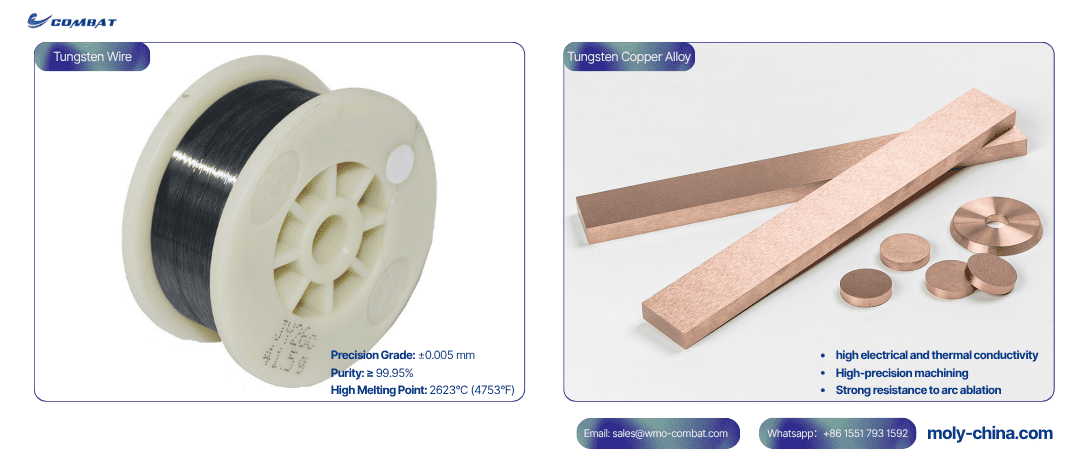
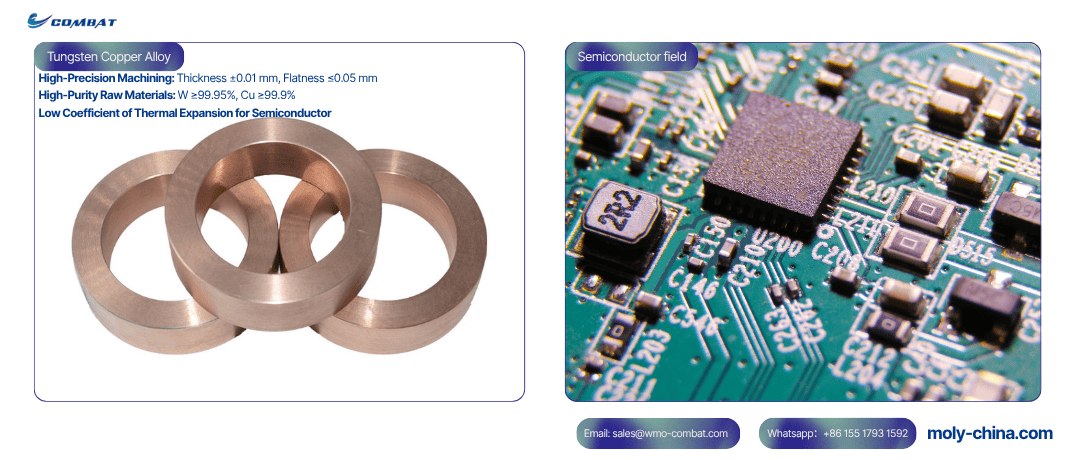
Tungsten is a high-temperature resistant heavy metal with the highest melting point of all metals, a property that makes it the material of choice for extreme high-temperature environments. At the same time, tungsten has extremely high density and hardness, good ductility, and can be drawn into thin tungsten wire or tungsten tape. Tungsten-copper alloy is widely used in electrical contacts, lighting filaments and various electronic components. Tungsten electrodes are even more indispensable components in the tungsten argon arc welding (TIG) process. Their high temperature resistance and refractory properties directly determine the welding quality.
Molybdenum (Mo): A Widely Used Refractory Metal
Molybdenum is also a refractory metal, but its melting point and density are lower than tungsten. Due to its balanced properties, it has become one of the most widely used general-purpose refractory metals.
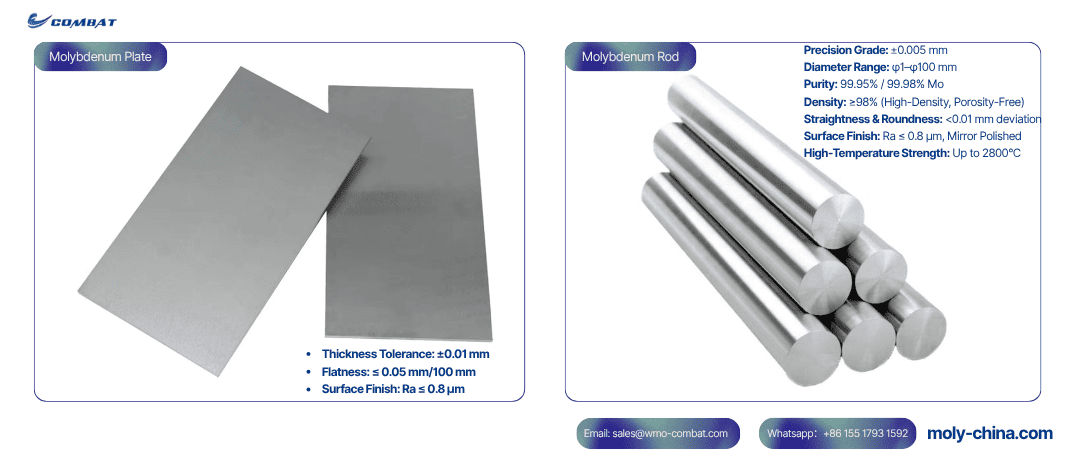
Molybdenum has excellent electrical conductivity, low thermal expansion coefficient and high strength, and is widely used in semiconductor substrates, industrial motors, aerospace components and defense fields.
Titanium (Ti): Lightweight and Corrosion-Resistant
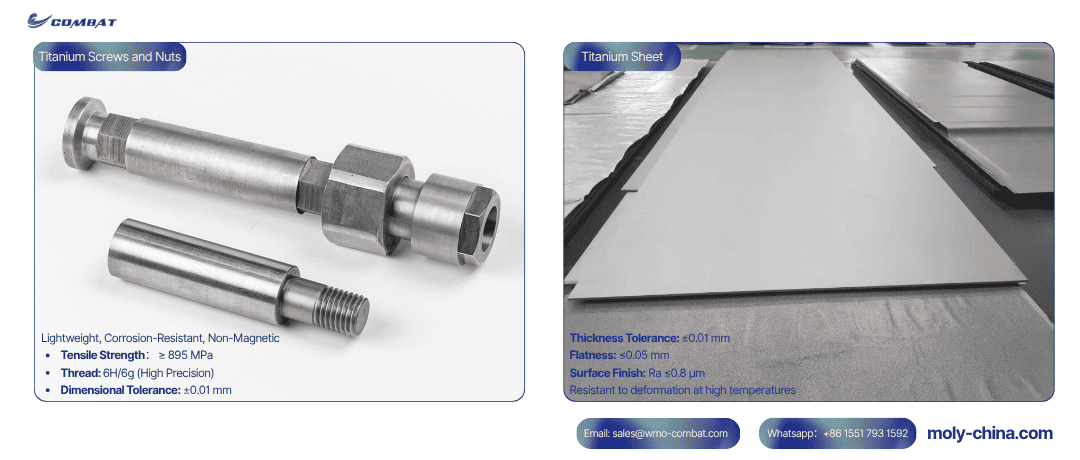
Titanium is a special refractory metal. Although its melting point is lower than that of tungsten, molybdenum and tantalum, about 1668℃, it still has good high-temperature stability. Titanium has good ductility and can be processed into a variety of titanium metal parts. At the same time, titanium can resist the corrosion of most acids and seawater, and has both strength and toughness. Titanium's properties give it an irreplaceable position in aerospace structural parts, medical implants, chemical equipment and marine engineering.
Tantalum (Ta): High stability
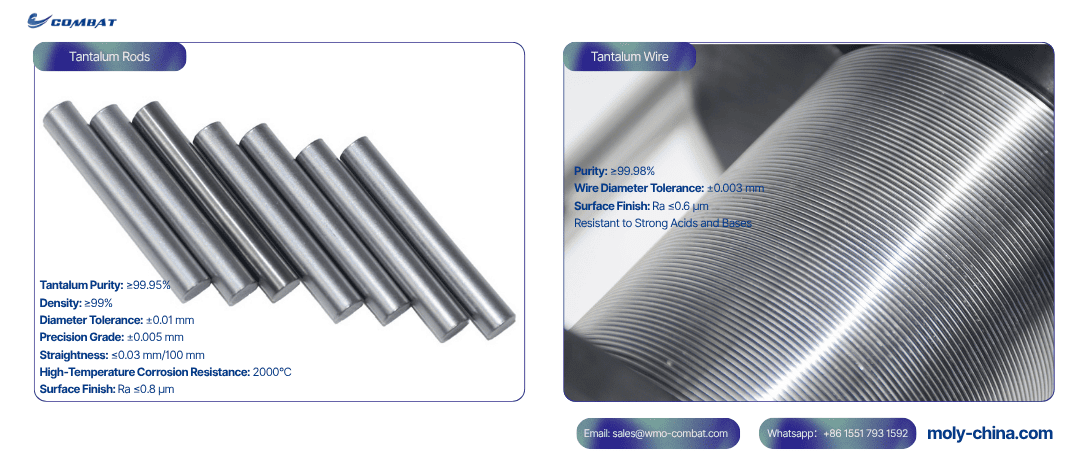
Tantalum has a series of excellent properties, including high melting point, low vapor pressure, good cold working performance, extremely high chemical stability, and high dielectric constant of the surface oxide film. It is the core refractory metal in the high-end field.
Its most outstanding advantage is its corrosion resistance, which is particularly excellent in acidic environments and is suitable for use in demanding chemical production equipment. At the same time, tantalum has excellent biocompatibility and is one of the ideal materials for medical implants.
Comparison of Refractory Metal Properties
Detailed Metal-by-Metal Comparison
| Performance indicators | Tungsten (W) | Molybdenum (Mo) | Titanium (Ti) | Tantalum (Ta) |
| Melting point (℃) | 3422 (highest) | 2623 | 1668 | 3020 |
| Density (g/cm³) | 19.3 (highest) | 10.2 | 4.51 | 16.6 |
| Machinability | Difficult | Good | Good | Moderate |
| corrosion resistance | Moderate | Moderate | Excellent | Excellent |
| Thermal conductivity | Highest | High | Medium | Low Medium |
| Low ductility | Medium | Low | High | High |
| Price | Medium | Lowest | Medium | Highest |
| Core advantages | Ultra-high temperature resistance | Versatility + high cost performance | Lightweight + corrosion resistance | Extremely high chemical stability + biocompatibility |
Core Performance Depth Analysis
High temperature resistance: tungsten > tantalum > molybdenum > titanium
High temperature resistance is the core characteristic of refractory metals. Among them, tungsten has a melting point of up to 3422℃, far exceeding that of the other three metals. It is the only choice for extreme scenarios such as ultra-high temperature furnace components and rocket nozzles.
The melting points of tantalum and molybdenum are 3020℃ and 2623℃ respectively, which are suitable for medium and high temperature environments; although the melting point of titanium is 1668℃, it is relatively low among refractory metals and is more suitable for medium and low temperature, weight-sensitive scenarios.
Weight characteristics: Titanium (lightest) vs Tungsten (heaviest)
The density of the four metals varies significantly. Titanium has a density of only 4.51g/cm³, which is about one-quarter that of tungsten. It is an ideal material for aerospace and lightweight equipment, and can reduce the overall weight while ensuring strength.
Tungsten has a density of up to 19.3g/cm³, making it suitable for scenarios requiring concentrated weight, such as crankshaft counterweights, aircraft counterweights, radiation shielding, etc., and can achieve weight requirements in small spaces.
Corrosion resistance: Tantalum > Titanium > Molybdenum > Tungsten
Tantalum has the best corrosion resistance. It can resist the erosion of most strong acids and bases. It is even insoluble in aqua regia (only soluble in hydrofluoric acid). It is the first choice for chemical equipment and components for corrosive environments.
Titanium is second in corrosion resistance, especially suitable for seawater and weakly acidic environments; molybdenum and tungsten have medium corrosion resistance and are easily oxidized at high temperatures. They need to be protected by coatings (such as nickel and cadmium coatings) in humid environments.
Cost-effectiveness: molybdenum > tungsten > titanium > tantalum
Molybdenum is the lowest price among the four metals and has balanced performance, suitable for most conventional high-temperature applications and the highest cost-effectiveness; tungsten is of medium price and suitable for scenarios with high requirements for high-temperature resistance.
Titanium is medium to high in price, and its cost mainly comes from the difficulty of processing; tantalum is the most expensive and is a high-end special material. It is only used in high-tech and demanding working conditions with extreme performance requirements.
Application Of Refractory Metals
Application of tungsten and tungsten heavy alloys
Pure tungsten is mainly used in ultra-high temperature scenarios, such as heating elements and furnace wall components of ultra-high temperature furnaces, as well as tungsten TIG welding electrodes, and uses its ultra-high melting point and stability to ensure the normal operation of the equipment.
In actual production, tungsten heavy alloy (WHA) is more commonly used. This type of alloy contains 89%~97% pure tungsten. When combined with nickel, copper, nickel, iron and other elements, it can significantly improve workability and reduce costs.
Tungsten applications include: aircraft counterweights, ballast, racing counterweights, vibration damping, radiation shielding, military ammunition, etc. Among them, the most commonly used tungsten heavy alloy contains 92.5% tungsten, 5.25% nickel, and 2.25% iron, and is easy to mill, turn and drill.
Applications of molybdenum
Molybdenum is extremely versatile, and molybdenum applications are semiconductors, steel, aerospace and other fields. In semiconductor manufacturing, molybdenum is used as a substrate material to ensure chip production accuracy by utilizing its good conductivity and dimensional stability.
In the steel industry, molybdenum, as an alloy additive, can significantly improve the strength and corrosion resistance of steel and is widely used in machinery manufacturing, mining tools, etc. In addition, molybdenum is also used in industrial motors, vacuum heating systems, etc., and its cost-effectiveness advantage is outstanding.
Applications of titanium
The core applications of titanium are concentrated in “lightweight + corrosion resistant” demand scenarios. In the aerospace field, titanium is used to manufacture aircraft structural parts and engine components, reducing the weight of the fuselage while improving corrosion resistance.
In the medical field, titanium has excellent biocompatibility and is used to manufacture medical implants such as artificial joints and dental implants. It can be well combined with human tissues and is not easy to corrode. In addition, titanium is also used in chemical equipment and marine engineering to resist acid, alkali and seawater erosion.
Applications of tantalum
Tantalum is mainly used in high-end, demanding scenarios. In the field of electronics, tantalum is used to manufacture capacitors. The high dielectric constant of the oxide film on its surface is used to improve the capacity and stability of capacitors. It is widely used in automotive electronics and aerospace electronic equipment.
In the chemical industry, tantalum is used to manufacture reactors, heat exchangers and other equipment to resist harsh environments such as strong acids and high temperatures; in the medical field, tantalum is used to manufacture high-end medical implants, which have both biocompatibility and corrosion resistance.
How to Choose Refractory Metals for Your Industry?
To facilitate quick selection, the following summarizes the correspondence between common application scenarios and recommended metals, directly matching actual needs:
Ultra-high temperature furnace components: tungsten (ultra-high melting point, strong stability)
Lightweight aerospace components: Titanium (lightweight + high strength)
Acidic Environmental Chemical Equipment: Tantalum (Excellent Corrosion Resistance)
Semiconductor manufacturing: molybdenum (size stability + good conductivity)
Medical Implants: Tantalum/Titanium (Biocompatible + Corrosion Resistant)
Cost-sensitive high-temperature applications: molybdenum (high cost-effectiveness + balanced performance)
Small space counterweight/radiation shielding: tungsten (high density)
Manufacturing of refractory metal components
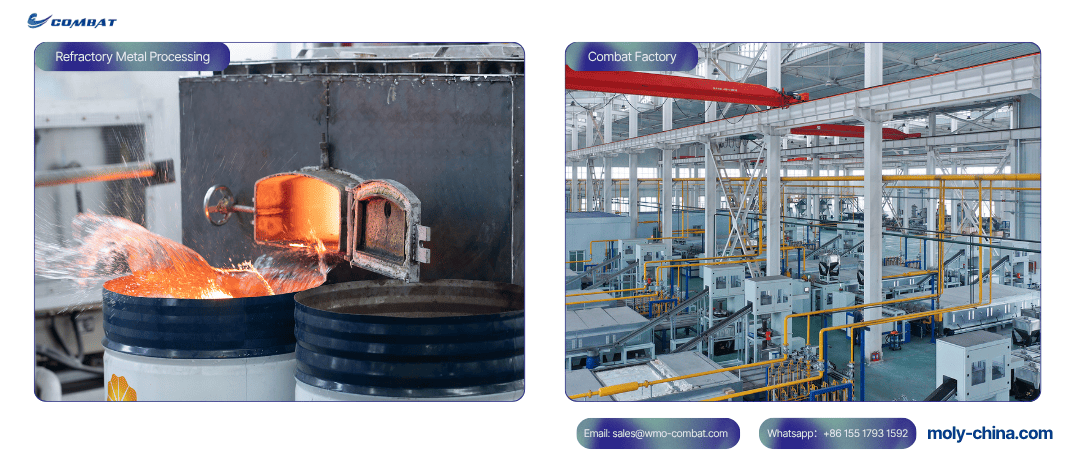
The processing difficulty of refractory metals is generally higher than that of conventional metals. Combat is a refractory metal materials supplier. The following provides practical suggestions for the processing and manufacturing of tungsten, molybdenum, titanium and tantalum.
Manufacturing tips for tungsten components
Pure tungsten has poor machinability, so tungsten heavy alloys are often used as substitutes in actual production, which significantly improves its machinability.
When machining tungsten heavy alloys, carbide tools can be used for milling, turning and drilling; coolant is required for roughing, and the maximum cutting depth can reach 1/8 inch; the cutting depth is controlled to within 0.030 inches for finishing, and coolant is not required. In addition, tungsten heavy alloys can be cold worked by rotary forging.
Molybdenum processing techniques
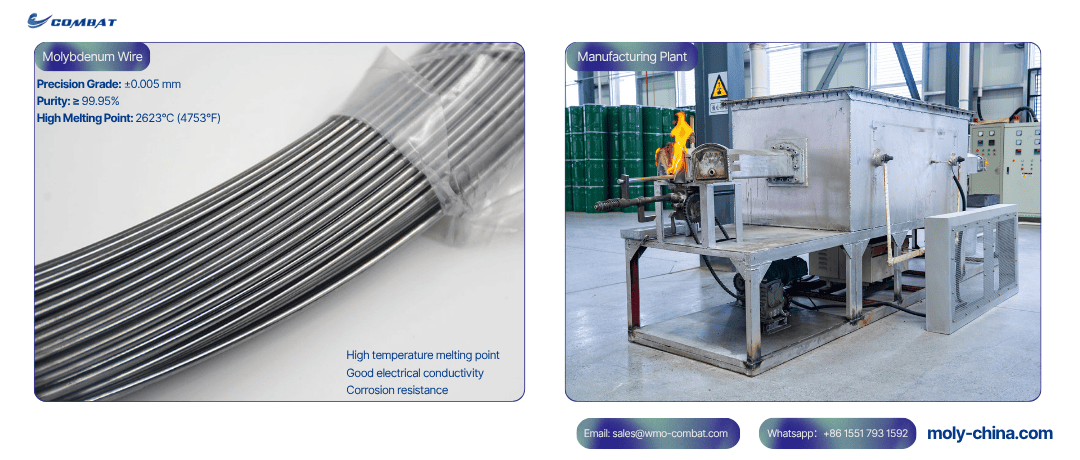
Molybdenum has a machinability close to that of stainless steel, but because it is abrasive, it will accelerate tool wear, so sharp cutting tools need to be used to avoid blade breakage.
During rough machining, the maximum cutting depth of molybdenum can reach 1/8 inch; during finishing, the cutting depth is controlled at 0.005~0.015 inches to ensure the precision of molybdenum metal processing. When welding molybdenum, chemical cleaning is required to remove impurities, and it is best to do it in a vacuum environment to avoid molybdenum absorbing nitrogen and oxygen, causing oxidation and embrittlement.
Titanium processing techniques
When machining titanium metal, the cutting speed and feed amount need to be controlled to avoid excessive temperature; at the same time, special coolant needs to be used to reduce tool wear and workpiece deformation. In addition, titanium metal welding needs to be protected with inert gas to prevent oxidation.
Tantalum processing techniques
During the processing of tantalum metal, the cutting force needs to be controlled to avoid deformation of the workpiece; when welding tantalum metal materials, it is also necessary to carry out it in a vacuum or inert gas environment to prevent oxidation and ensure welding quality.
Concluson
If you are still unable to determine the appropriate refractory metal, you can contact Combat's professional team to obtain customized refractory metal materials recommendations; at the same time, you can apply for detailed technical datasheets for tungsten heavy alloys, molybdenum alloys and other products, or inquire about product quotes to help you quickly complete material selection.