

What Drives Molybdenum Prices in 2026?
作者:kangbote 时间:2026-10-15 10:15:44
In 2026, the price of molybdenum continued to climb, hitting a multi-year high. Buyers in steel, oil and gas, high-end equipment, semiconductors and other industries are facing the same problem: molybdenum raw material quotations continue to rise, spot inventories are tight, and delivery cycles are lengthened.
The current molybdenum market has entered a structural shortage for many years. The cumulative gap reached 0.108 billion pounds by the end of 2025, spot inventories continued to be depleted, and short-term new supply projects were limited. Overlay China's molybdenum products export control, special steel demand growth, multiple factors together to support the 2026 high price of molybdenum operation.
1. Global Molybdenum Supply And Demand Data Analysis
Molybdenum Market in 2025
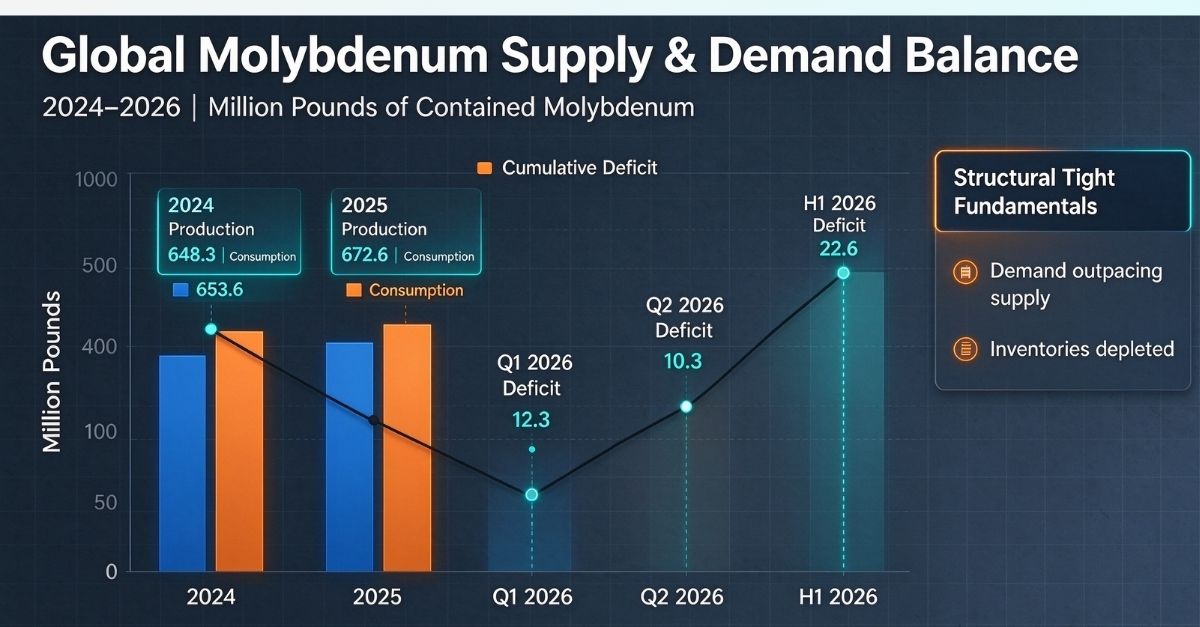
According to IMOA statistics for the whole year, global molybdenum production in 2025 was 0.6726 billion pounds, up 4% year-on-year. Consumption was 0.6718 billion pounds, up 3% year-on-year, with a slight surplus of about 0.008 billion pounds for the whole year, which is close to balance as a whole.
In terms of regional output, China is the world's largest producer, with 0.3021 billion pounds of output, a slight increase of 1%; South America produced 0.1756 billion pounds, basically the same; North America produced 0.1337 billion pounds, up 17% year-on-year, making it the strongest region in global supply growth.
The difference on the consumer side is more pronounced. China consumed 0.3378 billion pounds, up 9% year-on-year, with significant demand expansion; European consumption fell 7%; U.S. demand grew 3%; and the rest of the region declined slightly.
USGS's 2025 mine statistics show global molybdenum production of 260000 tons, up 2% year-on-year. China, Chile, the United States, Peru and Mexico together contribute about 90% of the world's mineral molybdenum.
First half of 2026: supply-demand gap widens rapidly
Global production in the first quarter of 2026 was 0.1684 billion pounds, flat month-on-month and + 2% year-on-year, while consumption was 0.1807 billion pounds, + 9% month-on-month and + 5% year-on-year, with a quarterly gap of 0.123 billion pounds.
Output in the 2 quarter was 0.1672 billion pounds, down 1% from the previous quarter. Consumption was 0.1775 billion pounds, up 8% year-on-year, leaving a gap of 0.103 billion pounds.
Combined with first-half data, global supply was 0.3356 billion pounds (0.6 percent year-on-year) and demand was 0.3582 billion pounds (8.5 percent year-on-year), with a cumulative gap of 0.226 billion pounds.
A key industry feature: About 60% of the world's molybdenum comes from copper ore associated by-products. Such production is determined by the copper mining plan, will not be due to rising molybdenum prices and rapid expansion of production the elasticity of supply is extremely low.
Inventory decline and long-term gap expectations.
By the end of 2025, the market will have a cumulative gap of about 0.108 billion pounds, equivalent to two months of global consumption. Spot negotiable inventory is consumed in large quantities and the buffer space is already small.
BMO predicts that 2027 will see the sixth consecutive year of supply and demand gap. The compound growth rate of molybdenum demand from 2020 to 2025 is 4.4, but the reserves of new mining projects are seriously insufficient, and there are no large-scale projects to fill the gap in the short term.
Regional supply constraints
Copper and molybdenum mines in South America (Chile, Peru) are facing multiple pressures such as declining ore grade, water shortage, delayed approval, and insufficient capital investment. In the 2 quarter of 2026, South American molybdenum output fell 9% year-on-year.
China's primary molybdenum mine capacity expansion is limited, superimposed on the export control policy introduced in early 2025, the outward transport of molybdenum raw materials tightened. The growth of emerging sources such as Myanmar is limited and cannot change the pattern of global tight balance.
2. Steel Industry Demand and Alloy Production
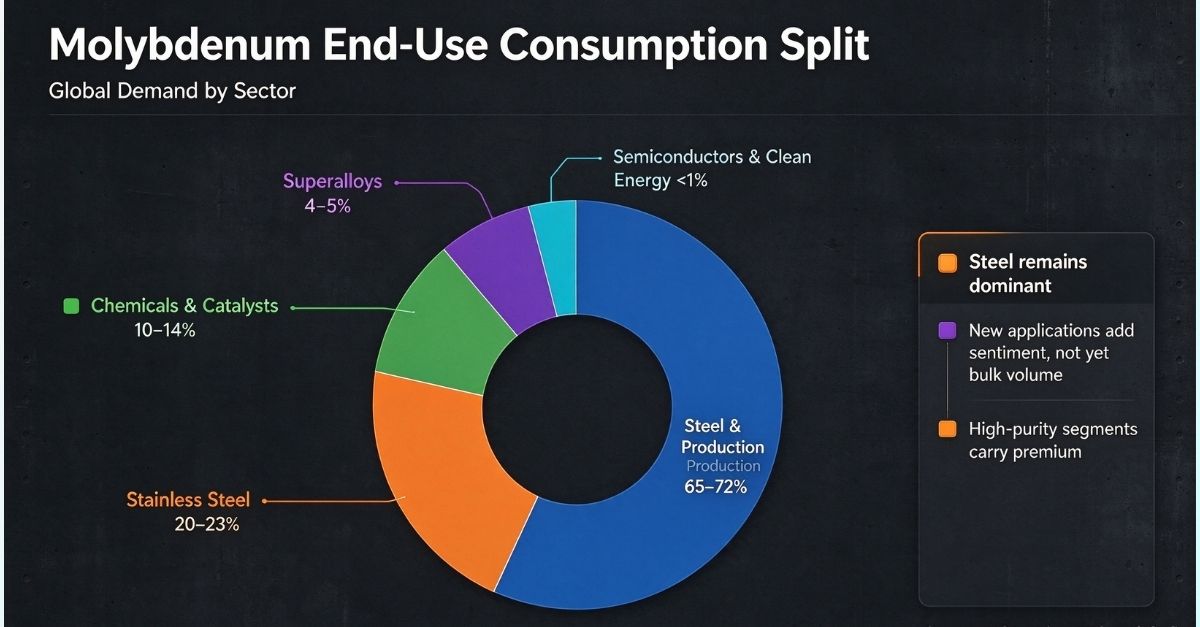
The steel industry occupies an absolute dominant position in global molybdenum consumption, with more than 80% of molybdenum used in the metallurgical field, of which alloy steel and stainless steel together account for 65%-72% of total demand.
The proportion of molybdenum added to steel is generally 0.1-0.8, and can reach 2%-7% in some stainless steel grades. It can improve the hardenability, strength, toughness, high temperature resistance and corrosion resistance of steel, and is widely used in infrastructure, energy, oil and gas, engineering machinery and automobile manufacturing.
In the steel cost structure, the proportion of molybdenum is very low. Even if the price of molybdenum continues to rise, steel mills will find it difficult to find fully equivalent alternative materials in the short term, and demand shows strong price inelasticity.
Demand for Stainless Steel and Special Alloys Continues to Grow
Stainless steel is the second largest metallurgical application of molybdenum, accounting for about 20%-23% of total demand. 316/316L, dual-phase steel relies on molybdenum to resist chloride ion pitting and crevice corrosion. Global stainless steel production in 2025 was 64.2 million tons, up 2.1 percent year-on-year, with China alone producing 40.9 million tons.
Engineering alloy steels, tool steels and high-temperature alloys are used in aerospace, power generation equipment, oil and gas anti-sulfur pipelines, and chemical equipment. Energy transition and high-end manufacturing continue to support this demand. The remaining applications include catalysts (10%-14%) and high-temperature alloys (4%-5%). Although the proportion is not high, it has steadily increased in the fields of clean fuels and exhaust gas treatment.
3. Mining Costs, Ore Grades and Production Constraints
Primary Molybdenum Mines vs. Copper-Mine Byproducts
60% of the global molybdenum comes from the associated products of porphyry copper-molybdenum ore, and the grade of ore molybdenum is only 0.01-0.05. Mine production plans revolve around copper metal, with molybdenum as a by-product. Molybdenum price increases can only increase by-product revenue, it is difficult to push the mine to significantly increase the scale of mining.
The proportion of primary molybdenum ore is relatively small, mainly concentrated in China and the United States. Primary ore can adjust production capacity and restart idle production lines according to molybdenum prices. China's primary molybdenum mines have historically been able to increase production rapidly in a tight cycle, but resource decay and tighter environmental policies have significantly weakened this resilience.
Energy, Labor and Processing Costs
Molybdenum production is a high energy consumption, heavy capital industry. The raw ore is crushed, ground and floated to produce molybdenum concentrate (grade 50-55%), and then roasted to obtain molybdenum trioxide, which is further processed into molybdenum iron, metal molybdenum or molybdenum chemicals.
Grinding, roasting process consumes a lot of electricity, pharmaceutical, labor, equipment maintenance is the core cost. Energy inflation, labor costs, and the appreciation of the local currency, such as the Chilean peso, continue to lift mine operating expenses.
Primary molybdenum mines rely on molybdenum products to cover all production costs, while associated mines rely on copper mine infrastructure to share costs. Although the rise in molybdenum prices has boosted mine profitability, the incremental release of production is limited, once again confirming the rigidity of supply.
4. Trade Policies, Tariffs and Geopolitical Risks
Since 2025, trade controls, tariff games, and geographical concentration of resources have amplified the tensions in the molybdenum market. The core trigger is China's molybdenum export licensing system introduced in early 2025, which, together with the U.S. tariff policy, pushes up cross-border procurement costs.
China Molybdenum Export Licensing Policy
In February 2025, the Ministry of Commerce announced No. 10 to implement export licensing management of molybdenum, tungsten, tellurium, bismuth, and indium. Molybdenum alloy with purity greater than 97%, molybdenum powder in the field of semiconductor and national defense, need to apply for an export license.
The policy is based on the Export Control Act and the Dual-Use Item Rule and is a response to the U.S. tariff measures. Not a blanket embargo, but a licensing administration. Bulk raw materials such as molybdenum concentrates and molybdenum oxide are still tradable, but the cross-border circulation of high-purity specialty molybdenum materials is restricted, and the control continues to take effect at the end of 2026. Purchasing companies in Europe, the United States and Japan that rely on Chinese intermediates continue to face supply chain uncertainty. Other countries have not issued a special export ban on similar molybdenum for the time being, but the global strategic mineral policy is tightening, and there is a risk of subsequent overweight.
Geopolitical risks associated with high concentration of resources
Global mine output is highly concentrated, with China, Chile, the United States, Peru, and Mexico 5 countries, which together contribute about 90% of molybdenum mine production. China accounts for 37%-45% of the world's mineral molybdenum, while consuming nearly half of the world's molybdenum. Most of the overseas supply comes from Chile and Peru copper associated with molybdenum, and the primary molybdenum production capacity is concentrated only in the United States and China.
This pattern means that South American mine shutdowns and domestic policy adjustments will directly disrupt global spot supply. Myanmar, Kazakhstan and other new supply volume is small, low grade, it is difficult to effectively spread the risk.
Aerospace, defense, high-end alloy steel industry, the substitution of molybdenum is very low, more vulnerable to supply shocks.
Shipping, Exchange Rates and Arrival Costs
Cross-border quotations for molybdenum oxide and ferromolybdenum include sea freight, insurance, customs duties and exchange rate costs. The main trade routes are South American mines, Chinese producers, and sent to Asia, Europe, and North America.
Shipping price increases, port congestion, and geo-shipping risks can widen the spread between the mine FOB price and the purchaser's CIF arrival price. A stronger dollar raises the real cost of non-dollar purchasers; the appreciation of the Chilean peso raises the cost of production at local mines, which is ultimately transmitted to export quotes.
The European market maintains single-digit import tariffs on ferromolybdenum, superimposed on the premium brought about by various trade frictions. Overseas molybdenum oxide quotations continued to strengthen in 2026, with spot quotations in Asia and Europe supported by gaps and logistics costs.
5.Emerging Demands for Semiconductors, Energy and Advanced Technologies
Semiconductors, AI computing power, clean energy is the market hot spot, driving the demand for high-purity molybdenum, but from the volume point of view, the short-term can not change the fundamentals of commodity supply and demand.
Semiconductor and AI Related Molybdenum Demand
Molybdenum is gradually replacing tungsten for 3D NAND flash memory word lines, and manufacturers such as Samsung and SK Hynix have completed commercial applications in the ninth generation of V-NAND and 3D NAND products above 375 layers.
The resistivity of molybdenum is 30%-40% lower than that of tungsten, and some structures can eliminate the barrier layer, which is more suitable for HBM high-bandwidth storage and AI computing chips in multi-layer stacks and small processes. ALD deposition equipment, high-purity materials manufacturers to promote mass production.
However, the actual consumption of the industry is very small, and the current global demand for semiconductor grade molybdenum is only tens of tons. Optimistic estimates by 2030, the total amount is only about 80 tons. Compared with the global 300000-ton market, the proportion is less than 1‰, and the need for special ultra-high purity grades, and metallurgical grade molybdenum is not the same track.
Oil and Gas, Power Generation and Clean Energy
- Molybdenum belongs to the mature non-steel demand in the oil and gas field. The oil and gas industry relies on molybdenum to manufacture X70-X100 sulfur-resistant pipeline steel, and hydrodesulfurization catalysts are also inseparable from molybdenum.
- Molybdenum is used in power generation for steam turbines and boiler superalloys, overlapping with aerospace superalloy requirements.
Clean energy track, wind power tower special steel, concentrated solar energy, nuclear power equipment, hydrogen energy equipment gradually increase the amount of molybdenum. The large-scale construction of offshore wind power continues to drive the consumption of high alloy steel.
- Power generation, chemical catalysts, and high-temperature alloys together constitute a steady increase, which is included in the long-term 4.4% compound growth base demand forecast.
Can emerging applications independently push up molybdenum prices?
In the short to medium term perspective of 2027-2030, the answer is no.
The demand for high-purity molybdenum tons of semiconductors is too small; the increase in the energy sector has been included in the existing steel demand forecast.
The impact of emerging demand is more reflected in three points: market sentiment speculation, high-purity molybdenum alone premium, strengthen the "long-term gap" industry narrative. What really determines the price of molybdenum commodities is still the traditional demand for alloy steel and stainless steel.
6. How Molybdenum Product Type and Specifications Affect Prices
The price of molybdenum is in accordance metallic molybdenum content pricing (USD/lb molybdenum, yuan/ton degree), not material gross weight. Different processing stages, purity, specifications, bring huge price difference.
Molybdenum Concentrate vs. Ferromolybdenum vs. Molybdenum Metal
Molybdenum concentrate (molybdenite, 45-55% Mo): The primary product of the mine after flotation is the raw material bottom bin of the entire industrial chain. Domestic often in yuan/ton quotations, impurities, origin (native/associated) to determine the rise of water.
Industrial molybdenum oxide MoO (about 57% Mo): concentrate roasting output, the world's core benchmark varieties, Busan, Rotterdam warehouse molybdenum oxide is the international market vane. The price is higher than the concentrate, including roasting energy consumption, desulfurization treatment costs.
Ferromolybdenum (60-70% Mo): the mainstream raw material for alloying in steel mills, made from molybdenum oxide smelting, with a processing premium compared to molybdenum oxide. Domestic steel mill bidding is the core mechanism of ferromolybdenum pricing. In a tight supply cycle, the molybdenum premium will expand significantly.
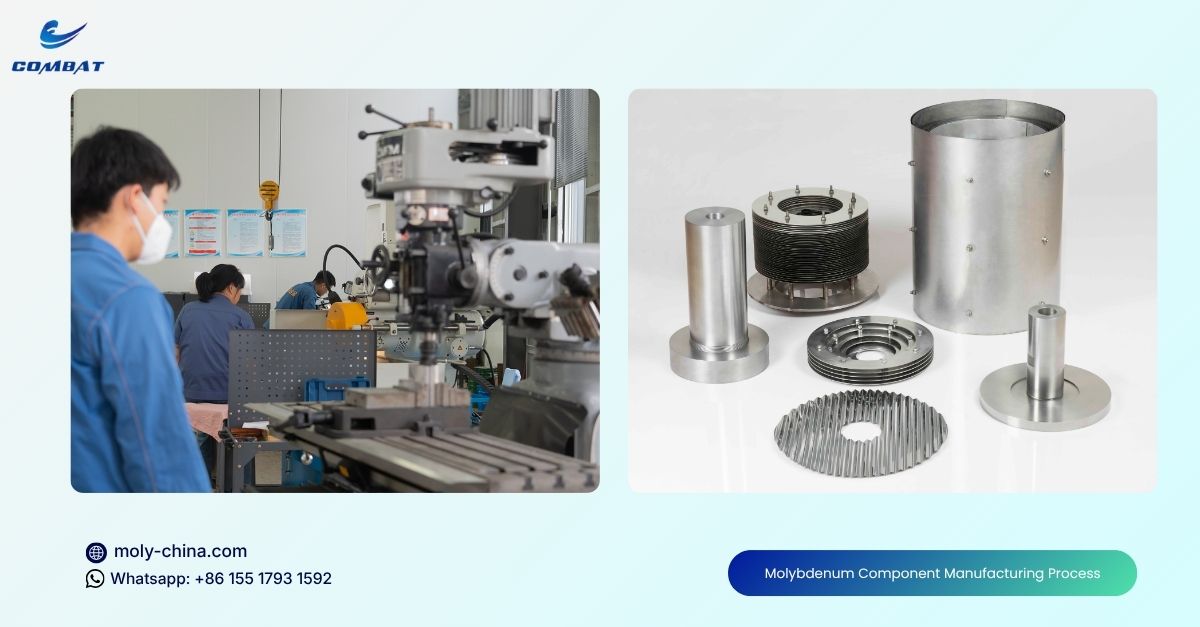
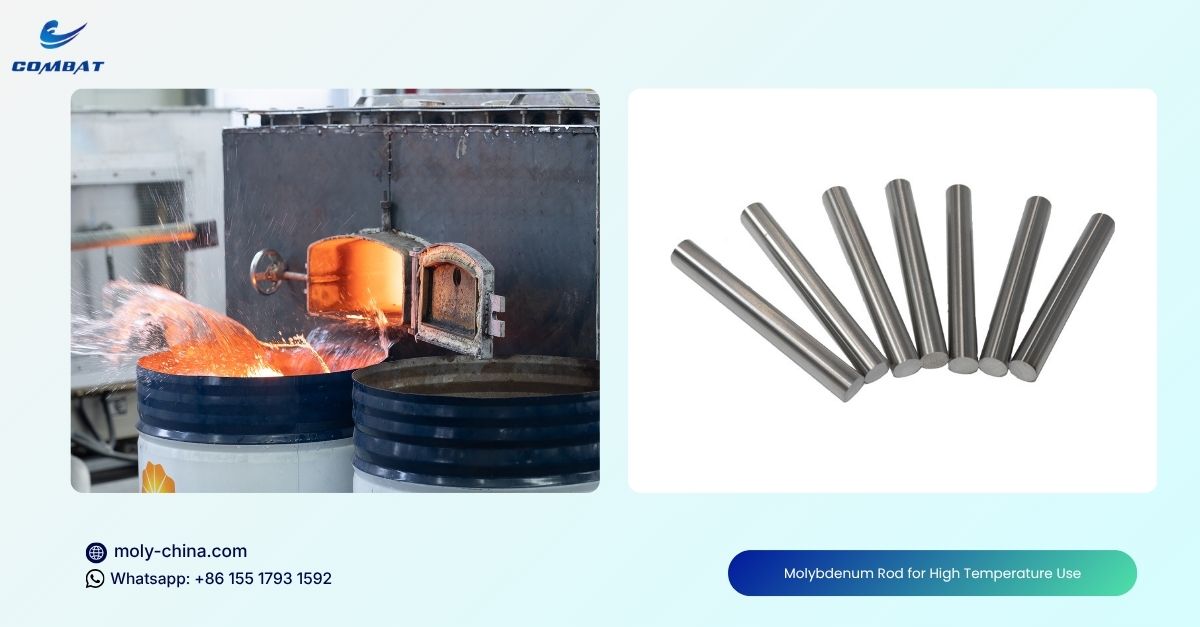
Metal molybdenum products (molybdenum powder, molybdenum rod, molybdenum plate, molybdenum wire, their purity ≥ 99.9-99.95%): after deep purification, used in chemical, electronic and vacuum equipment. There is a significant premium compared to molybdenum iron and molybdenum oxide. Semiconductor, aerospace 4N/5N ultra-high purity molybdenum, the price is higher.
Why Do Molybdenum Plate Suppliers Offer Different Prices?
Buyers often find that there are obvious differences in the quotations of molybdenum plates from different manufacturers, mainly from the following factors:
- Origin and cost basis: China's molybdenum suppliers rely on raw material scale advantages of low prices; European and American professional manufacturers in quality control, spot inventory, delivery time to charge a premium.
- Vertical industrial chain: integrated mining and metallurgical enterprises, compared with independent deep processing manufacturers; powder metallurgy and rolling process, the yield, cost is completely different.
- Certification and purity levels: ultra-high purity, strict tolerance, aerospace/semiconductor certified materials, significantly higher pricing, the market there is a risk of low purity as high purity materials.
- Molybdenum surface treatment, packaging: polished vs black leather, VCI anti-rust packaging, wooden box packaging affects the final cost.
- Trade terms: EXW ex-factory price, CIF, DDP delivery price, freight tariffs will bring huge differences.
Combat Metal can supply molybdenum concentrate, molybdenum oxide, molybdenum plate, molybdenum wire, molybdenum rod and high purity molybdenum products. It can provide complete material certification and is suitable for metallurgy, aerospace and semiconductor fields.
7. How Buyers Can Manage Molybdenum Price Volatility
In a market environment of persistent supply and demand gaps and low inventories, the risk of passive spot chasing high purchases is extremely high. Companies need to establish a systematic monitoring and procurement strategy.
Monitor the Right Market Indicators
Don't just stare at a single quote, you need to combine multi-dimensional indicators to judge the market:
- Core benchmarks: Busan, Rotterdam, China FOB molybdenum oxide, ferromolybdenum prices, focus on the price difference between concentrate, molybdenum oxide, ferromolybdenum, processing premium expansion, often on behalf of raw materials or roasting capacity constraints.
- Domestic steel mill molybdenum iron tender: tender volume, winning price, is the short-term demand leading indicator, tender strength usually drives the global molybdenum price upward.
- Supply signals: IMOA quarterly production and sales data, South American copper disturbance, domestic molybdenum concentrate output, export control policy updates.
- Inventory and trade flows: explicit warehouse inventory, import and export data, freight and exchange rate changes.
- Macro indicators: global crude steel, special steel production, energy infrastructure investment, institutional gap forecast.
Molybdenum Supplier selection based on total procurement cost
The lowest price is not equal to the best solution, and the total cost of ownership needs to be evaluated. Priority is given to the supply stability of molybdenum suppliers, preferably multi-origin (primary + associated), multi-source combination, with a stable inventory buffer of manufacturers. In the gap market, the loss of production due to delayed delivery is much higher than the small material premium.
It is recommended to spread to 2-4 qualified suppliers of molybdenum metal materials to reduce the risk of a single source, while maintaining a stable purchase volume from the main supplier in exchange for better business conditions.
FAQ About 2026 Molybdenum Price
Q1: What are the drivers of molybdenum price in 2026?
A: Global molybdenum supply and demand gap, steel production, mining costs, inventory consumption, China's export controls, plus emerging demand for semiconductor clean energy, together affect 2026 molybdenum prices.
Q2: Why is the price of molybdenum so expensive?
A: Global mine supply is limited, about 60% from copper associated ore, supply is difficult to increase rapidly with the rise in molybdenum prices. Molybdenum unique high strength, high temperature resistance, corrosion resistance, in the alloy manufacturing is difficult to find a complete alternative materials.
Q3: How is the price of molybdenum determined?
A: The price depends on the product form (concentrate, molybdenum oxide, ferromolybdenum, molybdenum metal), purity, spot supply, order quantity, contract terms. Molybdenum concentrate, molybdenum iron, molybdenum plate belong to different products, the benchmark price can not be directly compared.
Q4: What should buyers pay attention to before purchasing molybdenum products?
A: Molybdenum plate grade purity, size thickness, tolerance, surface treatment, processing difficulty, purchase quantity, delivery terms, supplier certification level will affect the quotation. There will be a significant premium for high-purity aviation and semiconductor-grade molybdenum plates.
Q5: Will the price of molybdenum continue to rise in 2026?
A: The gap in the first half of 2026 is 22.6 million pounds, the circulating inventory is low, the short-term new supply is limited, and the molybdenum price is likely to remain high. But molybdenum buyers need to keep track of molybdenum market data and policy dynamics.
Q6: Is the price per kilogram of molybdenum oxide, molybdenum alloy and pure molybdenum products the same?
Not the same. Quotations for molybdenum oxide may be based on molybdenum content, quotations for ferromolybdenum may be based on total alloy weight or molybdenum content, and prices for pure molybdenum products include processing and manufacturing costs.