

Tungsten Wire vs Molybdenum Wire for Heating Applications
作者:kangbote 时间:2026-10-29 11:01:15
In high temperature furnaces, vacuum furnaces, experimental equipment, electron beam systems and special filaments, tungsten and molybdenum wires can be used as heat generating or conductive functional materials. But the two are not simply "who has a higher melting point, who must be better". The choice of tungsten wire and molybdenum wire first depends on the working temperature, furnace atmosphere, energization method, mechanical support, thermal cycle and allowable material cost. For procurement personnel and equipment engineers, the more important issues are: under its own equipment conditions, which wire can work more stably and can continuously obtain consistent quality. This article will compare material properties, working atmosphere, temperature range, mechanical strength, resistance design, failure mode and supplier inquiry requirements.
What Is the Difference Between Tungsten Wire and Molybdenum Wire?
Both tungsten wire and molybdenum wire belong to refractory metal wire. They can maintain good strength and dimensional stability at high temperatures, so they are often used in heating, supporting, conducting and emitting parts that ordinary wires cannot withstand.
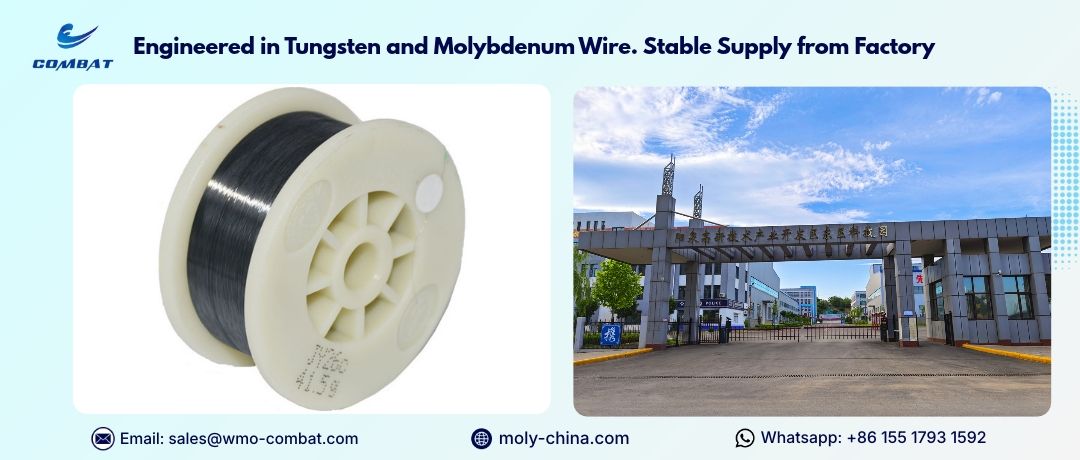
Tungsten wire is a metal wire mainly composed of tungsten. Tungsten has a melting point of about 3422°C, high density, outstanding high-temperature strength, and can withstand high thermal loads in high vacuum or strictly controlled inert atmospheres. It is usually used for extremely high temperature filaments, electron emission components, electron beam systems and some special high temperature heating elements.
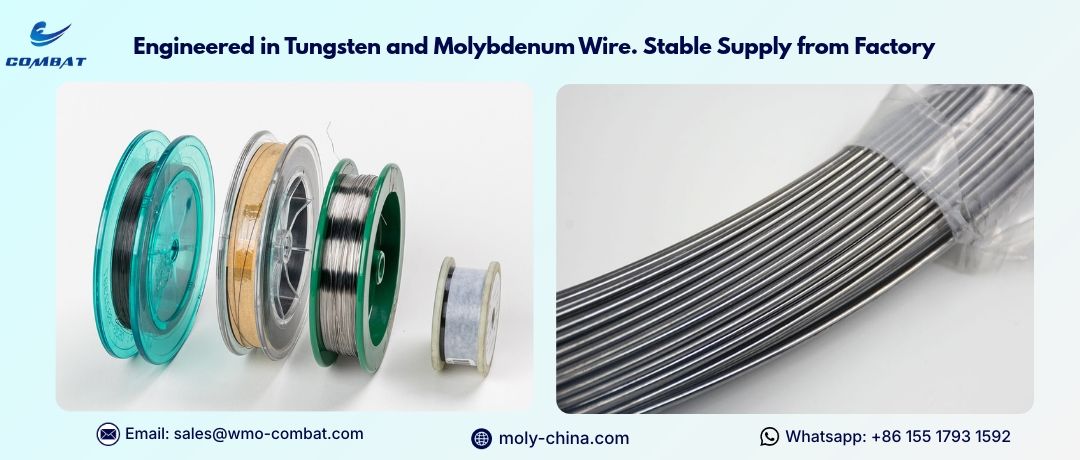
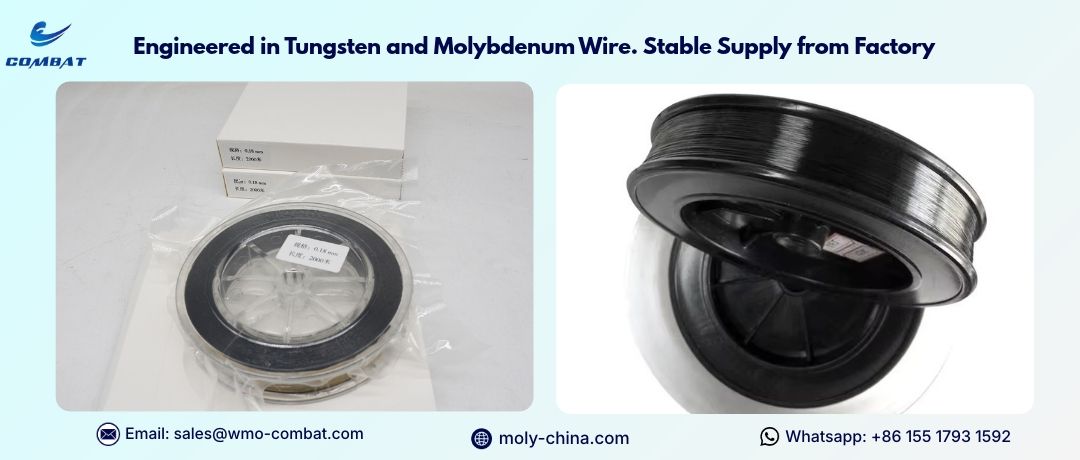
Molybdenum wire is a metal wire mainly composed of molybdenum. Molybdenum has a melting point of about 2623°C and a lower density than tungsten, making it suitable for a variety of furnace parts with electrical and thermal conductivity. Molybdenum wire is usually used in vacuum furnaces, protective atmosphere furnaces, heat treatment equipment, electronic tube parts, electrical discharge machining and high temperature structural parts. Different grades, annealing state, work hardening degree and wire diameter will obviously affect its final performance.
The following table summarizes the typical differences between the two refractory metal materials. The values in the table are representative data of common pure metals, and the actual products shall be subject to the specific brand, the supply status of tungsten and molybdenum wires and the manufacturer's inspection report.
|
Property |
Tungsten Wire |
Molybdenum Wire |
|
Melting point |
Approximately 3422°C |
Approximately 2623°C |
|
Room-temperature density |
Approximately 19.3 g/cm³ |
Approximately 10.3 g/cm³ |
|
High-temperature strength |
Excellent at extremely high temperature |
Very good within its suitable temperature range |
|
Oxidation resistance |
Poor in air at elevated temperature |
Poor in air at elevated temperature |
|
Typical atmosphere |
High vacuum or controlled inert gas |
Vacuum, inert gas, or controlled reducing atmosphere |
|
Machinability |
Difficult, especially for fine precision parts |
Generally easier than tungsten |
|
Typical cost tendency |
Usually higher |
Usually more economical |
|
Common heating uses |
Extreme-temperature filaments and specialized heaters |
Furnace heaters, wires, supports, and thermal components |
|
Main risk |
Brittleness, recrystallization, sagging, and oxidation |
Oxidation, embrittlement, recrystallization, and thermal distortion |
The melting point of the material cannot be directly equivalent to the recommended operating temperature. The actual use temperature is also affected by the wire diameter, heating length, radiation conditions, support spacing, surface state, furnace contamination and thermal cycle speed. For continuous operation equipment, the design temperature usually needs to be lower than the theoretical melting point of the material, and sufficient engineering margin is retained.
When Should You Choose Tungsten Wire for Heating?
Tungsten wire is often more advantageous when the equipment requires extremely high operating temperatures and can maintain a high vacuum or a strictly controlled inert atmosphere.
The main advantages of tungsten are high temperature strength and high melting point. In a very high temperature environment, the tungsten wire can withstand a large radiation heat load. For components that require high power density, local rapid heating or extremely high temperature radiation, tungsten filaments can provide more design space.
However, tungsten wires are not suitable for all heating equipment. Tungsten oxidizes rapidly in high-temperature air to produce volatile oxides. Even short-term exposure to an oxygen-containing environment may cause cross-section thinning, surface chalking, and resistance changes. As a result, tungsten filament heating elements are typically required to operate in a high vacuum, inert atmosphere with controlled purity, or other proven non-oxidizing environment.
The tungsten wire also has a high brittleness. After high temperature operation, the grain may grow and the room temperature bending performance of the material will decrease. For parts that require frequent disassembly, repeated bending, or mechanical impact, the maintenance requirements of tungsten wires are usually higher than those of molybdenum wires. Designers need to minimize sharp bends, local stress concentrations and unreasonable clamping.
Tungsten wire is more suitable for the following situations:
- The temperature in the furnace is close to the upper limit of the application of ordinary molybdenum wire;
- Requires high power density or local extremely high temperature;
- The equipment can maintain a high vacuum or a proven inert atmosphere;
- The heating element does not need to be bent frequently after installation;
- Products allow for higher material costs and greater emphasis on extreme temperature capability.
In electron emission, special filament and electron beam systems, the tungsten filament may also assume the emission function, rather than simply generating heat. At this time, it is necessary to consider the electron emission performance, coil geometry, energizing current, surface treatment and thermal electron stability at the same time, and the selection method of heating wire for ordinary furnace cannot be directly applied.
When Is Molybdenum Wire the Better Choice?
Molybdenum wire is usually a more balanced choice if the equipment is operating in the medium to high temperature range, using vacuum, inert atmosphere or controlled reducing environment, and is sensitive to processability, dimensional stability and cost.
Although the melting point of molybdenum is lower than that of tungsten, it can meet the working temperature requirements in many vacuum heat treatment furnaces, sintering furnaces, electronic equipment and experimental furnaces. The advantage of molybdenum wire is not only the price is relatively friendly, but also includes better processing and forming adaptability. Molybdenum wires are generally easier to manufacture and assemble for heating elements that need to be wound, braided, bent, welded, or fabricated with complex structures.
In the hot zone of the vacuum furnace, molybdenum wires can be used for heating wires, connecting wires, supporting wires, hanging wires and some auxiliary conductive parts. For repair parts that require periodic replacement, molybdenum wire is also often used as a common stock material by equipment repairers. If the maximum temperature of the equipment does not exceed the applicable range of molybdenum wire, the use of tungsten wire may increase the cost and processing difficulty, but it does not necessarily bring about the actual life improvement.
Molybdenum wire is suitable for the following situations:
- The operating temperature is within the range that the molybdenum material can withstand stably;
- The equipment uses vacuum, inert gas or low oxygen environment;
- Heating elements require winding, bending or complex assembly;
- Periodic maintenance and replacement of spare parts;
- Purchasers need to strike a balance between performance, processability and cost.
It is important to note that molybdenum is also susceptible to oxidation in high temperature air. The so-called "molybdenum wire is more suitable for industrial heating than tungsten wire" does not mean that molybdenum wire can be directly exposed to the air for long-term work. As long as the temperature is high enough, oxidation will become the main failure mechanism. Therefore, the furnace sealing, vacuum pumping capacity, protection gas purity and furnace cooling process must be included in the material selection.
Tungsten Wire vs Molybdenum Wire by Operating Atmosphere
The working atmosphere often determines whether the heating wire can be used earlier than the melting point of the material. The same wire may run stably in high vacuum, but it will fail quickly in air.
High Vacuum
High vacuum is usually one of the most suitable environments for tungsten and molybdenum wires. The low oxygen content can significantly reduce the risk of high temperature oxidation. But a high vacuum does not mean that there are no other risks. The residual moisture, oil vapor, cleaning agent, adhesive volatiles and workpiece surface contamination in the furnace may react with the high temperature metal wire.
For the heating wire of the vacuum furnace, the purchasing and engineering personnel should also confirm the limit vacuum, working vacuum, pumping rate, volatile release during the heating stage, and whether there are halogen, sulfur, phosphorus or carbon-based pollution sources in the furnace.
Inert Gas
Protective atmospheres such as argon, helium, and high-purity nitrogen can reduce the risk of oxidation, but the purity, dew point, and flow rate of the protective gas are critical. Microamounts of oxygen and moisture may still cause oxidation, volatilization or surface reactions at high temperatures.
Tungsten wire is usually suitable for more stringent atmosphere control. Molybdenum wire has good comprehensiveness in some protective atmosphere applications, but it still needs to be verified according to the actual temperature and gas purity. The words "nitrogen" or "argon" cannot be used to determine the safety of the material.
Reducing Atmosphere
Some reducing environments can reduce the stability of oxides, but the reaction behavior of different gas systems is different. Hydrogen, carbon-containing gases and mixed gases may cause decarburization, carburization, embrittlement or surface reactions. The suitability of the material should be evaluated based on the specific gas composition, temperature, pressure and residence time.
Air or Oxygen-Containing Atmosphere
Tungsten wire and molybdenum wire are usually not suitable for use as a bare heating wire in high temperature air for a long time. If the equipment must be heated in air, it is usually necessary to consider metal oxide heating materials, alloy heating wires, ceramic protection tubes or other special heating structures.
This is an important border: tungsten and molybdenum are high-temperature refractory metals, but they are not "air heating wires" that can work directly in any atmosphere ".
How Do Temperature, Resistance, and Wire Diameter Affect Selection?
The working state of the heating wire is not determined by the material name alone. The wire diameter, effective length, resistivity and power supply mode jointly determine the heating power and surface temperature.
These formulas can help the engineer with the preliminary design, but cannot be used alone to determine the final furnace temperature. The actual radiation temperature is also affected by the surface emissivity of the heating wire, the heat absorption of the workpiece, the reflection of the furnace wall, the heat dissipation of the support and the vacuum condition.
As the wire diameter of the tungsten or molybdenum wire increases, the resistance per unit length decreases, requiring a longer effective length or a higher operating current to achieve the target power. When the diameter of tungsten wire or molybdenum wire decreases, the resistance increases, and the surface temperature may rise rapidly, but the mechanical strength and thermal shock resistance will also decrease.
|
Design Variable |
Effect on Heating Performance |
Procurement Concern |
|
Wire diameter |
Changes resistance per unit length and mechanical strength |
Confirm diameter tolerance and measurement method |
|
Heated length |
Changes total resistance and heat distribution |
Define effective length, not only total cut length |
|
Coil pitch |
Influences radiation, local temperature, and spacing |
Provide winding diameter and pitch |
|
Electrical resistivity |
Determines current and voltage requirements |
Confirm material grade and test temperature |
|
Support spacing |
Affects sagging and thermal stress |
Share fixture drawing or support layout |
|
Surface condition |
Affects emissivity and contamination behavior |
Specify surface finish and cleaning condition |
|
Lead connection |
Influences local heating and contact loss |
Define welded, clamped, or threaded connection |
|
Thermal cycling |
Controls fatigue and recrystallization risk |
Provide ramp rate, cycle count, and cooling method |
For example, a vacuum furnace repairer needed to replace 1 sets of molybdenum wire heating elements. If only "molybdenum wire with a diameter of 1mm and a length of 10 m" is provided, the supplier of tungsten and molybdenum metal materials still cannot accurately judge whether the product is suitable. It is also necessary to know the target resistance or supply voltage, effective heating length, winding diameter, pitch, support point spacing, working temperature, vacuum degree and connection method.
A more complete description of the inquiry should include: "Molybdenum wire, specified grade or purity, diameter and tolerances, annealed or hardened state, surface cleaning requirements, effective heating length, winding inner diameter, pitch, end connection type, target resistance or power supply parameters, maximum operating temperature, furnace atmosphere and packaging method."
This kind of specification information can significantly reduce the quotation round trip, and also prevent the supplier from quoting only according to the weight, and the final delivered wire cannot be installed or the resistance does not match.
Heating Wire Failure Modes and Diagnostic Methods
The failure of tungsten and molybdenum wires is usually not caused by a single cause. There is a clear coupling relationship between material selection, furnace atmosphere, mechanical support and electrical control.
|
Observable Symptom |
Likely Cause |
Verification Method |
Corrective Direction |
|
Surface becomes powdery or dull |
Oxidation or contamination |
Inspect atmosphere records and surface condition |
Improve sealing, gas purity, and cleaning |
|
Wire breaks during cold maintenance |
High-temperature embrittlement or recrystallization |
Compare used and unused wire bend behavior |
Reduce thermal stress and review material condition |
|
Wire sags after several cycles |
Creep, excessive temperature, or insufficient support |
Inspect support spacing and temperature distribution |
Increase support, reduce hot-spot temperature, or review grade |
|
Local bright spot appears |
Uneven resistance, poor connection, or local thinning |
Measure resistance and inspect terminals |
Improve connection and check diameter uniformity |
|
Heating power changes over time |
Oxidation, evaporation, contamination, or geometry change |
Record cold resistance before and after cycles |
Investigate atmosphere and replace unstable sections |
|
Wire fails near the terminal |
Stress concentration or poor joint design |
Inspect weld, clamp, and bend radius |
Use a transition section and reduce local mechanical stress |
|
Furnace temperature is uneven |
Incorrect coil pitch, spacing, or radiation geometry |
Map temperature at multiple positions |
Adjust winding, spacing, and zone control |
Oxidation
High temperature oxidation will reduce the wire section, increase the resistance and form a local hot spot, and finally accelerate the fracture. Even contact with air during the temperature rise phase can cause damage. Therefore, the furnace should be opened after the heating wire is fully cooled, and the moisture and volatiles in the furnace should be controlled.
Sagging and Creep
The heating wire may sag under the action of high temperature and self-weight, and thin wires, long spans and high temperature will further increase the risk. In addition to adjusting the material or wire diameter, check the support spacing, installation preload and temperature distribution. Increasing the intermediate support or shortening the free span is usually more effective.
Recrystallization and Embrittlement
Multiple high temperature cycles may cause the tungsten and molybdenum wires to recrystallize, making them more brittle after cooling. Used heating wire should not be repeatedly straightened or bent, disassembly should also avoid impact and sharp bend. The annealing state and applicable forming method shall be specified at the time of purchase.
Local Hot Spots
Wire diameter deviation, poor contact, uneven coil spacing or support shielding may form local hot spots. When bright spots are found, check the electrical connection, coil structure and temperature distribution first. If the root cause is not ruled out, only the replacement of the heating wire may still fail again in the same position.
Tungsten Wire vs Molybdenum Wire for Common Heating Applications
The optimal materials for different devices are not the same. The following application judgment is the preliminary screening of the project and shall not replace the verification based on actual working conditions.
|
Application |
More Suitable Starting Choice |
Why |
Main Boundary |
|
Vacuum furnace hot-zone heater |
Molybdenum wire |
Good balance of temperature capability, forming, and cost |
Verify vacuum quality and maximum temperature |
|
Ultra-high-temperature filament |
Tungsten wire |
Higher melting point and high-temperature strength |
Requires strict atmosphere control |
|
Laboratory vacuum heater |
Molybdenum or tungsten |
Depends on temperature, size, and replacement frequency |
Confirm thermal cycle and support design |
|
Electron-emission filament |
Tungsten or specialized tungsten alloy |
Strong high-temperature and emission performance |
Requires emission and geometry validation |
|
Protective-atmosphere furnace |
Molybdenum as initial option |
Often easier to fabricate and maintain |
Gas purity and dew point are critical |
|
Air-exposed heater |
Usually neither bare tungsten nor bare molybdenum |
High-temperature oxidation is a major risk |
Consider oxidation-resistant heating materials |
|
Furnace support or lead wire |
Molybdenum in many cases |
Good balance of strength and manufacturability |
Check local temperature and electrical load |
|
Very fine high-temperature wire |
Tungsten may be considered |
Suitable for some high-temperature filament designs |
Brittleness and handling risk must be controlled |
Molybdenum wire in the hot zone of the vacuum furnace is usually a reasonable first candidate because it can cover many medium and high temperature conditions and is easy to wind, repair and replace. If the temperature of the equipment is significantly higher, or the heating element needs to withstand a particularly high radiation load, consider the tungsten wire again.
The selection logic of the tungsten filament is different for the filament and the electron emitting part. At this time, not only the temperature needs to be considered, but also the emission capacity, coil geometry, heating rate and surface state. Can not be directly replaced by ordinary vacuum furnace heating wire specifications.
How to Specify Tungsten or Molybdenum Wire for a Supplier?
A enforceable inquiry document shall allow the supplier to judge the material, size, electrical and environment at the same time. Just writing "tungsten wire" or "molybdenum wire" is usually not enough to get an accurate quote.
It is recommended that the following information be provided at the time of inquiry:
- Material name, grade or purity requirements;
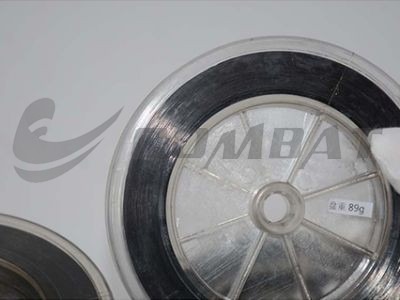
- Wire diameter, length, allowable tolerance and disc weight;
- soft state, semi-hard state, hard state or annealed state;
- Straight wire, coiled wire, wound wire, braided wire or finished heating wire;
- Target resistance, supply voltage, current and power;
- Working temperature, heating rate, holding time and cycle times;
- Vacuum degree, type, purity and dew point of protective gas;
- Coil outside diameter, inside diameter, pitch, number of turns and end form;
- Support structure, fixing method and connection method;
- Surface cleaning, degreasing, pickling or other treatment requirements;
- Packing method, quantity, sample requirements and target delivery time.
For bulk procurement, tungsten and molybdenum metal material suppliers should also be required to provide material batch, chemical composition, wire diameter inspection, surface condition and resistance test information. If tungsten wire or molybdenum wire is used in semiconductor, photovoltaic, medical or high-end furnace equipment, it should also be confirmed in advance whether more stringent clean packaging, change management and traceability documents are required.
Tungsten wire and molybdenum wire suppliers cannot judge applicability by product name alone. Truly reliable quotations should be based on drawings, working conditions and acceptance criteria. If the customer does not have a complete drawing, at least provide photos of equipment type, furnace temperature, atmosphere, power supply parameters and existing heating wire.
Cost, Lifetime, and Total Ownership Considerations
The unit price of tungsten wire is usually higher than that of molybdenum wire, but the unit price is not the whole cost. A more reasonable purchasing judgment should also consider material cost, processing cost, installation time, downtime loss, inventory cost and replacement frequency.
If the molybdenum wire has been able to meet the operating temperature and atmosphere requirements, the use of molybdenum wire can often reduce procurement and processing costs. Molybdenum wire may also reduce special winding and assembly costs because it is easier to form. For repairers, molybdenum wires of common sizes can be used as standard inventory to shorten the waiting time for equipment downtime.
If the operating temperature is close to the applicable boundary of the molybdenum wire, the continued use of the molybdenum wire may cause frequent sagging, breakage or resistance drift. At this time, although the initial cost of tungsten wire is higher, it is possible to reduce the total cost of ownership through higher temperature margin and longer stable operation period.
However, can not be a general promise of tungsten wire "life must be longer". Life depends on temperature, atmosphere, power control, wire size, support, contamination, thermal cycling and maintenance procedures. Vendor shall avoid giving fixed life hours without actual furnace type and operating data.
Purchasers of tungsten and molybdenum metal materials can begin their evaluation with the following questions:
- Whether the refractory metal material works within the recommended temperature range.If the working temperature is much lower than the upper limit of the material, the processing, delivery time and cost are preferred. If the temperature is close to the upper limit, the high temperature strength and thermal cycle stability should be evaluated first.
- Whether the atmosphere is real and controllable.If the equipment leaks frequently, the purity of the protective gas fluctuates or the furnace temperature is too high, the best refractory metal wire will oxidize quickly.
- Does the failure result in high downtime costs.For continuous production equipment, spare parts delivery and convenience of replacement may be more important than the unit price of materials.
- Whether tungsten and molybdenum material suppliers can maintain batch consistency. The use of wires with different resistivity, wire diameter or annealing state in the same equipment may lead to changes in power distribution and reduced temperature uniformity.
Frequently Asked Questions About Tungsten Wire or Molybdenum Wire
Q: Which is better, tungsten wire or molybdenum wire for heating?
There is no absolute answer. Extremely high temperature, high vacuum and high power density applications usually give priority to tungsten wire; medium and high temperature vacuum furnaces, protective atmosphere furnaces and applications requiring frequent processing and maintenance usually give priority to molybdenum wire. The final choice depends on temperature, atmosphere, wire diameter, support structure and number of cycles.
Q: Can molybdenum wire be used as a heating element?
You can. Molybdenum wire can be used for heating elements in vacuum furnaces, protective atmosphere furnaces, experimental furnaces and some electronic equipment, but oxygen content, moisture and volatiles must be controlled. Molybdenum wire is not suitable for long-term use as a bare heating wire in high temperature air.
Q: When should tungsten wire be selected for high-temperature heating?
When the equipment temperature is close to the stable working boundary of the molybdenum wire, higher high temperature strength and heat load capacity are required, and the equipment can maintain a high vacuum or controlled inert atmosphere, the tungsten wire can be evaluated preferentially. It is also necessary to confirm whether the brittleness, forming and maintenance conditions of the tungsten wire are acceptable.
Q: Are tungsten wire and molybdenum wire interchangeable?
Usually not directly interchangeable. The resistivity, density, high temperature strength, thermal expansion behavior, forming state and applicable temperature of the two materials are different. After replacing the material, it is often necessary to recalculate the wire length, wire diameter, power supply parameters, coil structure and support spacing.
Q: How do you choose heating wire diameter and resistance?
Determine the required resistance based on the target power, voltage or current, and then combine the material resistivity, heating length and allowable surface load to determine the wire diameter. Finally, it needs to be verified by the temperature distribution in the furnace, the support mode and the thermal cycle. Only by replacing the original wire diameter does not necessarily maintain the same heating performance.
Q: What documents should a tungsten wire and molybdenum wire supplier provide?
Common documents include material grade or purity certificate, size inspection report, batch identification, chemical composition or material report, surface condition description and resistance test record. For high-demand equipment, clean packaging, change notice and traceability requirements should also be confirmed in advance.
Conclusion
Tungsten wire and molybdenum wire can be used for high temperature heating, but the selection criteria is not simply to compare the melting point. Tungsten wire is more suitable for extremely high temperature, high vacuum and high thermal load scenarios; molybdenum wire is usually more suitable for vacuum furnaces and protective atmosphere furnaces that require a comprehensive balance of temperature capability, processability, maintenance convenience and cost.
If you are selecting tungsten or molybdenum wire for vacuum furnaces, sintering furnaces or experimental equipment, you can contact COMBAT to submit wire diameter, length, target resistance, operating temperature, atmosphere and drawing information for targeted material and specification evaluation.